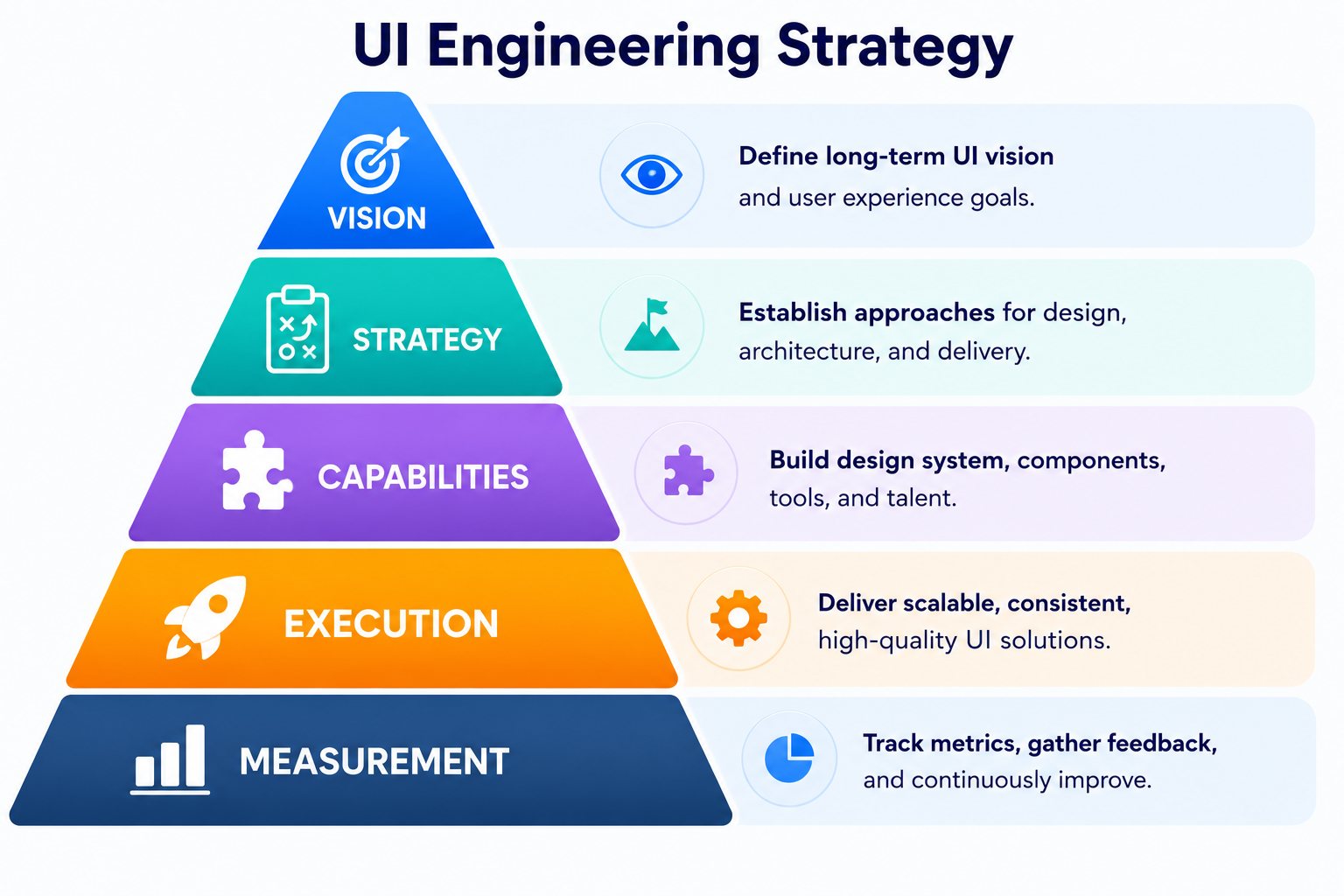
This blueprint presents a comprehensive engineering strategy for designing, developing, and scaling a modern Enterprise ERP Frontend Platform.
It establishes a practical framework covering engineering leadership, frontend architecture, design systems, delivery excellence, governance, AI-enabled development, and long-term platform evolution.
Rather than focusing solely on technologies, this document defines the engineering principles, organizational practices, and execution models required to build sustainable enterprise software.
This document is intended to be read sequentially. Each chapter builds upon the previous one, progressing from business strategy to engineering leadership, platform architecture, governance, delivery excellence, AI-enabled engineering, organizational transformation, and long-term engineering vision.
Individual chapters may also be referenced independently when defining engineering standards, evaluating architecture, planning organizational improvements, or supporting executive decision-making.
01
Chapter 01
Executive Summary
Opening Perspective
Enterprise software is built through disciplined engineering, not individual technical excellence. Sustainable products emerge when business strategy, product vision, architecture, engineering culture, and execution operate as one integrated system.
Modern Enterprise Resource Planning (ERP) platforms are expected to support increasingly complex business operations while remaining reliable, scalable, and easy to evolve.
Organizations today evaluate software not only by the number of features it offers, but also by the consistency of user experience, engineering quality, delivery speed, operational stability, and long-term maintainability.
As engineering teams grow and business requirements become more dynamic, isolated technical decisions are no longer sufficient.
A successful ERP platform requires a unified engineering strategy that aligns business objectives, product vision, architecture, engineering standards, delivery practices, and organizational culture.
This blueprint has been prepared to establish that strategic foundation.
Strategic Vision
Build a modern Enterprise Frontend Engineering organization capable of delivering scalable, maintainable, secure, and high-performance ERP applications through disciplined engineering practices and long-term architectural thinking.
The objective is not only to deliver software efficiently, but also to establish an engineering platform that continues to support business growth as products, teams, and customer expectations evolve.
Business Objectives
This blueprint supports the following organizational objectives:
Align engineering investments with business priorities.
Improve product quality and user experience.
Standardize engineering practices across teams.
Build reusable engineering platforms.
Reduce technical debt.
Improve delivery predictability.
Accelerate engineering productivity.
Enable sustainable product evolution.
Engineering Philosophy
The recommendations presented throughout this blueprint are based on several guiding principles.
Business Alignment
Engineering investments should always support measurable business outcomes.
Technology should enable business growth rather than become an operational burden.
Platform Thinking
Reusable engineering capabilities create greater long-term value than isolated project implementations.
Shared platforms improve consistency while reducing engineering effort.
Simplicity
Architecture should simplify development rather than increase complexity.
Simple systems remain easier to maintain, extend, and scale.
Continuous Improvement
Engineering maturity is achieved through incremental improvement supported by measurement, learning, and disciplined execution.
Shared Ownership
Quality, security, performance, and operational reliability should be considered collective engineering responsibilities.
Expected Outcomes
Successful implementation of this blueprint should enable the organization to achieve:
Faster product delivery.
Consistent engineering practices.
Improved software quality.
Better developer experience.
Higher component reuse.
Reduced maintenance effort.
Stronger architecture governance.
Sustainable engineering growth.
Blueprint Scope
This document provides strategic guidance covering:
Business Strategy
Product Strategy
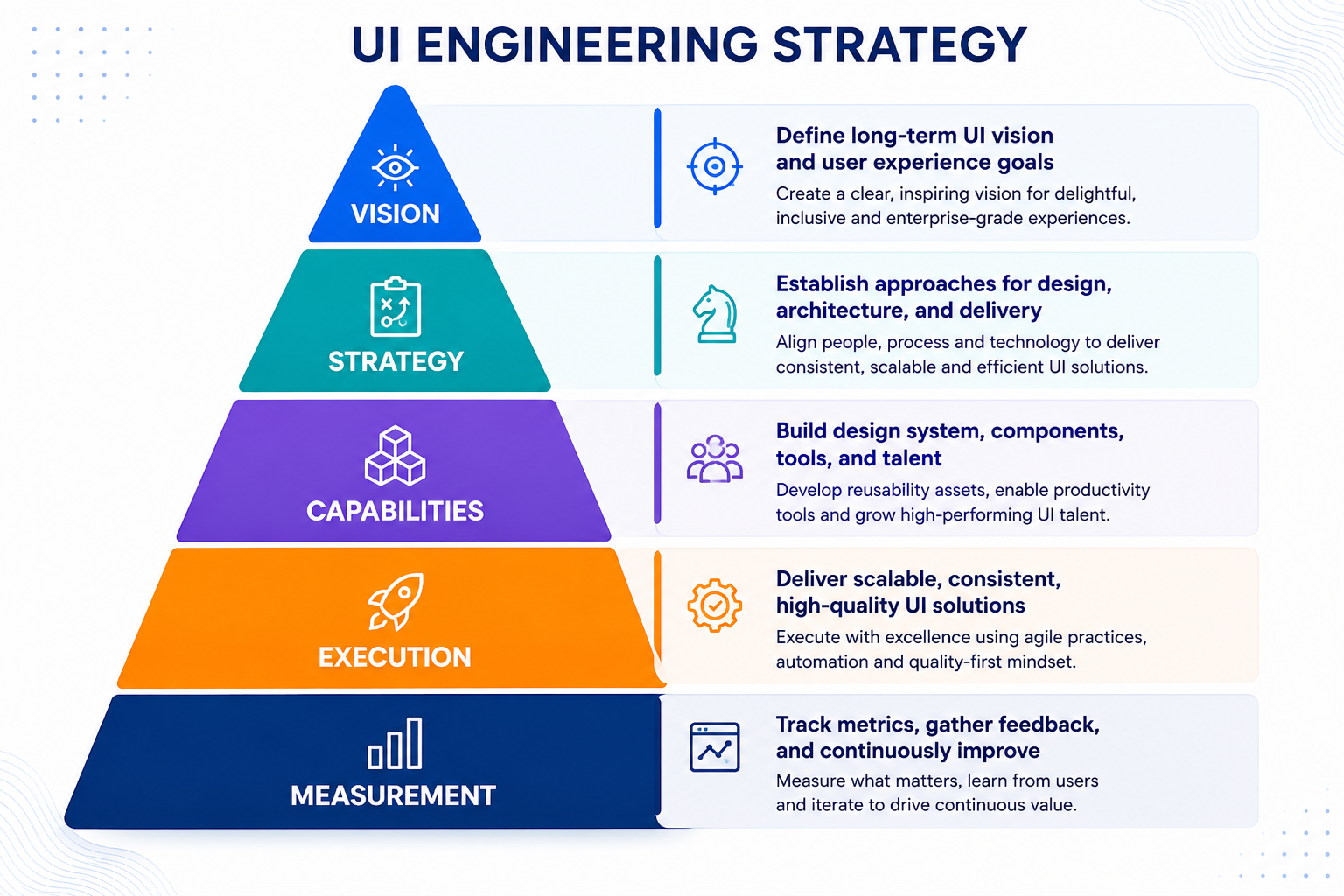
UI Engineering Vision
Engineering Leadership
Engineering Organization
Enterprise Frontend Architecture
Design System Strategy
Enterprise Component Library
Engineering Standards
Engineering Delivery Model
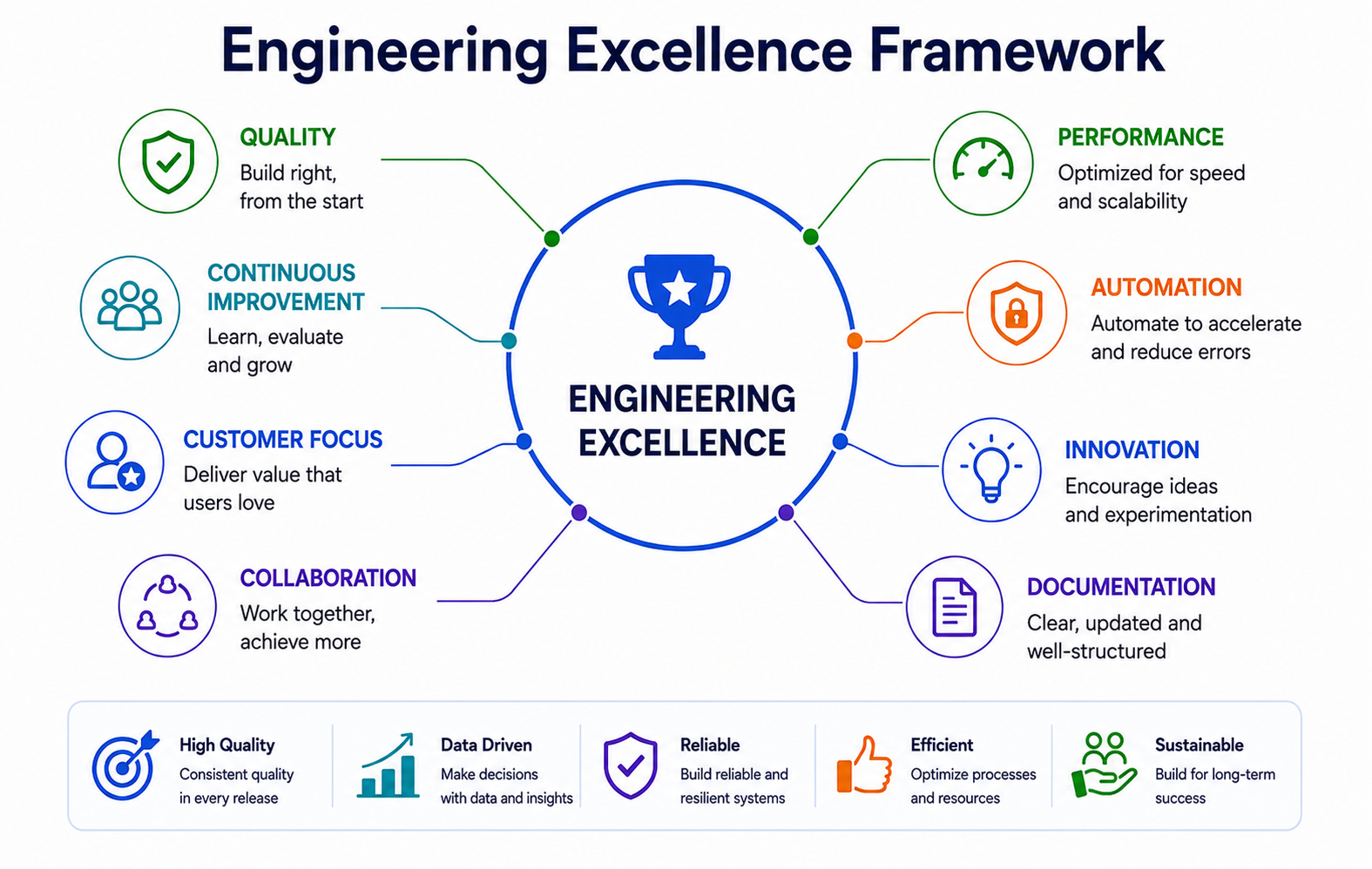
Engineering Excellence Framework
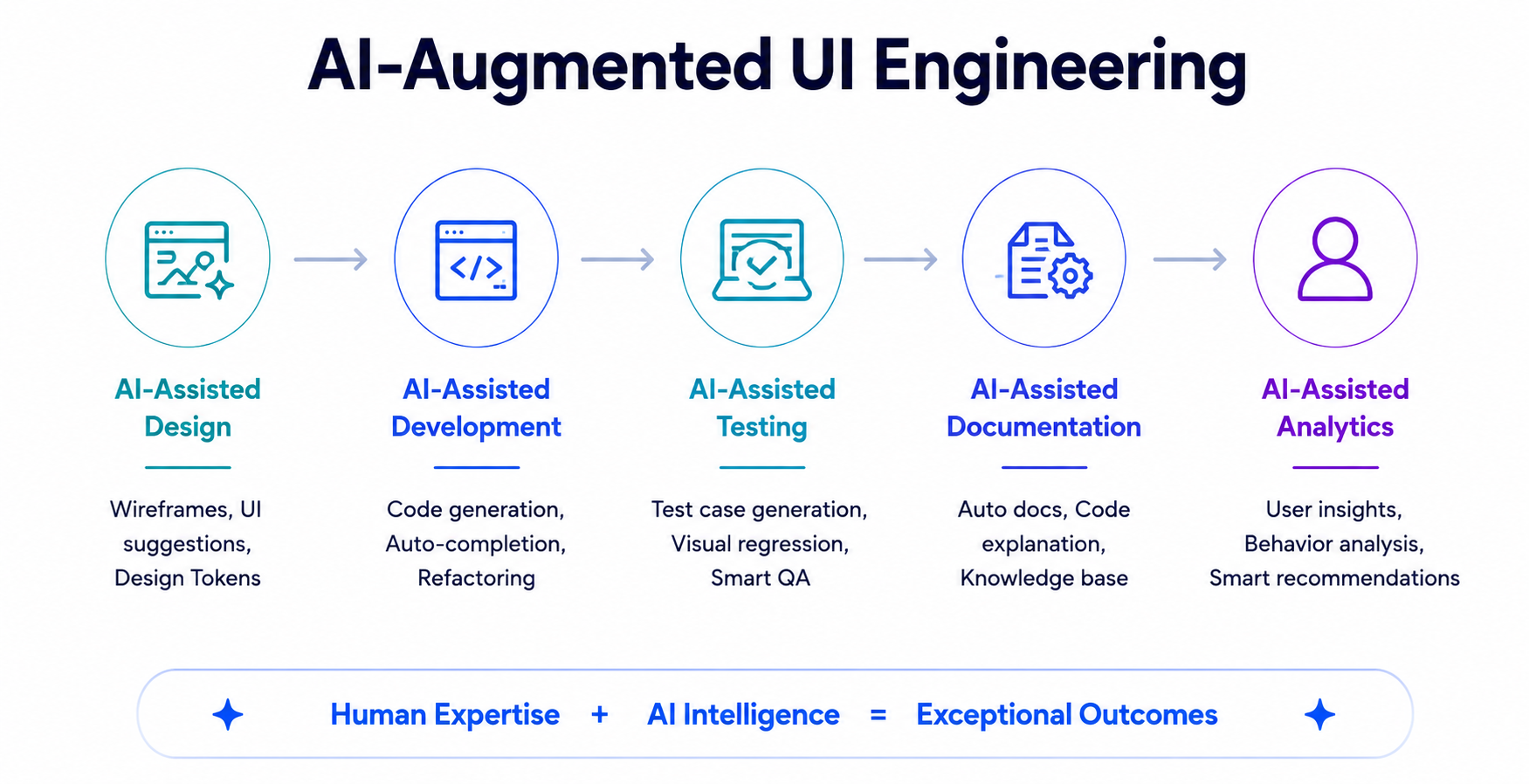
AI-Augmented Engineering
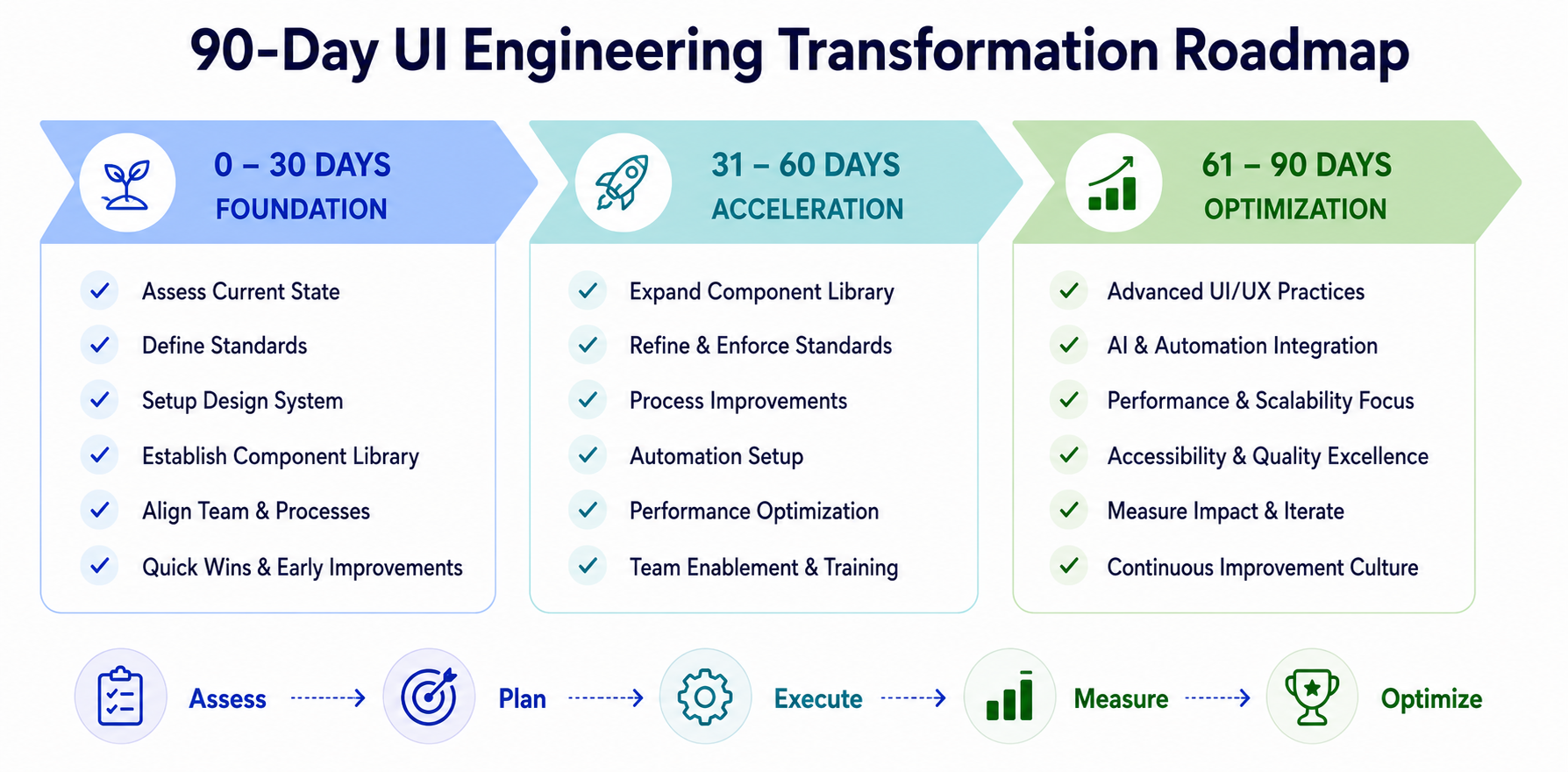
90-Day Transformation Roadmap
Future Vision
Together, these chapters define a complete framework for building and scaling an enterprise-grade frontend engineering organization.
Engineering Recommendations
Immediate Priorities
Establish common engineering standards.
Define architecture governance.
Standardize project structure.
Introduce reusable engineering assets.
Medium-term Priorities
Build a centralized Design System.
Expand the Enterprise Component Library.
Improve engineering documentation.
Strengthen delivery processes.
Long-term Priorities
Invest in platform engineering.
Scale AI-augmented development.
Continuously improve engineering maturity.
Measure organizational performance through engineering metrics.
Leadership Perspective
Engineering should be viewed as a strategic business capability rather than a software delivery function.
Organizations that invest in architecture, engineering culture, governance, and reusable platforms build products that remain maintainable, scalable, and competitive over the long term.
Leadership is responsible for creating an environment where engineering excellence becomes a repeatable organizational capability.
Key Takeaways
Business strategy should guide engineering decisions.
This chapter establishes the strategic context for the entire blueprint.
It introduces the engineering philosophy, business objectives, and long-term vision that guide every recommendation presented throughout the remaining chapters.
The next chapter examines the Business Strategy that aligns engineering investments with organizational goals and customer value, providing the business foundation upon which the entire engineering platform is built.
02
Chapter 02
Business Strategy
Strategic Context
Technology creates capabilities. Business strategy determines where those capabilities create value. Sustainable engineering organizations align every technical investment with measurable business outcomes.
Every capability must solve a genuine customer problem.
02Excellence
Technology should simplify operations and improve efficiency.
03Platform
Build a unified business platform, not isolated modules.
Executive Context
Enterprise Resource Planning (ERP) platforms have evolved from operational software into strategic business platforms.
Organizations now expect ERP systems to improve operational efficiency, increase visibility across business functions, simplify decision-making, and enable continuous business growth.
As products become more sophisticated, engineering teams must understand that every architectural decision, engineering investment, and product enhancement has a direct impact on business performance.
A successful engineering organization therefore requires a business strategy that provides clear direction for technology, product development, and long-term platform evolution.
Strategic Vision
Build an ERP platform that enables organizations to operate efficiently through standardized business processes, intuitive user experiences, scalable architecture, and continuous innovation.
The platform should evolve as a long-term business asset capable of adapting to changing customer needs while maintaining operational stability and engineering excellence.
Business Objectives
The engineering organization should continuously support the following business objectives:
Improve operational efficiency.
Simplify business workflows.
Increase organizational productivity.
Enhance decision-making through reliable information.
Reduce manual effort through automation.
Improve customer satisfaction.
Support sustainable business growth.
Deliver measurable business value through technology.
Every engineering initiative should contribute directly to one or more of these objectives.
Strategic Business Principles
The business strategy is built upon several foundational principles.
Customer Value
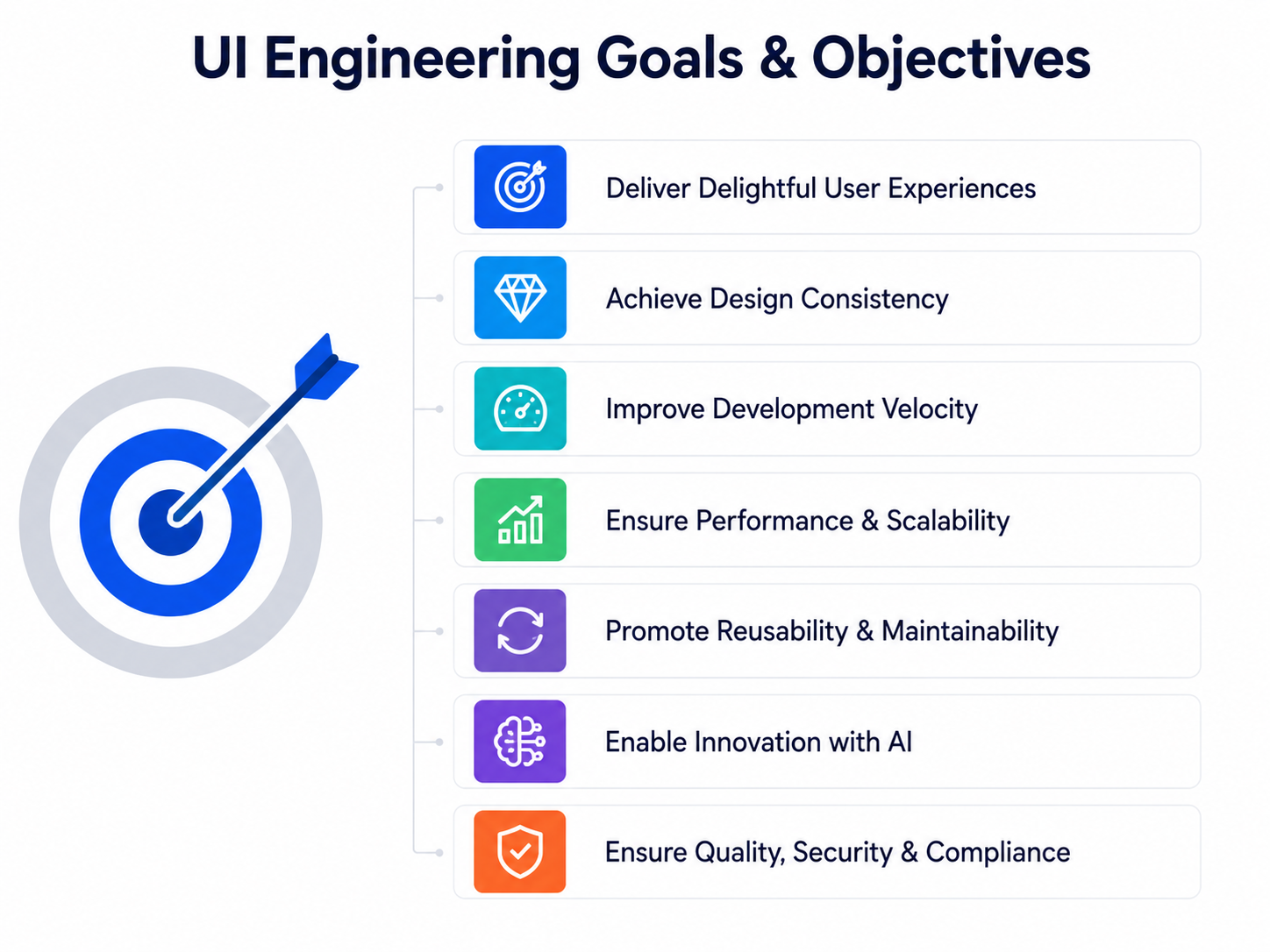
Visual Reference
◆ UI Engineering Goals & Objectives Diagram
Every product capability should solve a genuine customer problem or improve an existing business process.
Feature development should be driven by customer value rather than feature quantity.
Operational Excellence
Technology should simplify operations by reducing unnecessary complexity and improving process efficiency.
Engineering success should be measured by the business outcomes delivered rather than the volume of code produced.
Platform Thinking
The ERP solution should operate as a unified business platform rather than a collection of independent modules.
Shared capabilities, common workflows, and reusable engineering assets create long-term value while reducing operational complexity.
Sustainable Growth
Short-term delivery should never compromise long-term scalability.
Architecture, engineering standards, and delivery practices should support continuous product evolution.
Continuous Innovation
Business strategy should encourage ongoing improvement through customer feedback, engineering learning, automation, and responsible adoption of emerging technologies.
Innovation should create measurable business value rather than change for its own sake.
Engineering Alignment
Business strategy becomes effective only when engineering execution remains aligned with organizational priorities.
Engineering teams should:
Understand business objectives.
Participate in product planning.
Evaluate technical trade-offs.
Balance delivery speed with maintainability.
Continuously improve engineering capability.
Strong alignment between business and engineering reduces delivery risk while improving long-term product quality.
Success Indicators
Business success should be measured using meaningful outcomes rather than activity metrics.
Representative indicators include:
Customer adoption
User satisfaction
Delivery predictability
Product quality
Operational efficiency
Engineering productivity
Platform scalability
Customer retention
These indicators help leadership evaluate whether engineering investments are producing sustainable business value.
Engineering Recommendations
Immediate Priorities
Align engineering goals with business priorities.
Define measurable product objectives.
Standardize engineering planning.
Improve communication between Product and Engineering.
Medium-term Priorities
Build reusable platform capabilities.
Improve workflow automation.
Strengthen engineering governance.
Increase customer feedback integration.
Long-term Priorities
Continuously optimize business processes.
Expand platform capabilities.
Improve engineering maturity through measurable outcomes.
Establish technology as a long-term competitive advantage.
Leadership Perspective
Business strategy should provide direction without restricting innovation.
Engineering leaders must understand customer needs, business priorities, and organizational objectives while ensuring that technical decisions remain sustainable over the long term.
Organizations that successfully align business strategy with engineering execution consistently deliver products that remain valuable, adaptable, and competitive.
Key Takeaways
Business objectives should guide engineering decisions.
Customer value is the primary measure of product success.
Innovation should create measurable business value.
Engineering and business must evolve together.
Chapter Summary
A successful ERP platform begins with a clear business strategy that aligns customer value, organizational goals, and engineering execution.
By establishing shared objectives, encouraging platform thinking, and investing in sustainable engineering practices, organizations create a strong business foundation capable of supporting long-term product evolution.
The next chapter introduces the Product Strategy, defining how business objectives are translated into product planning, feature prioritization, and disciplined product execution.
03
Chapter 03
UI Product Strategy
Product Context
Successful products are built through disciplined strategy, thoughtful prioritization, and continuous alignment between customer needs, business goals, and engineering execution.
Business discovery and structured requirement analysis.
02Plan
Roadmap prioritization aligned with customer and business value.
03Deliver
Design, build, release, and continuously improve the platform.
Executive Context
Enterprise Resource Planning (ERP) systems are expected to support complex business operations while remaining intuitive, reliable, and adaptable to changing business requirements.
A successful ERP product is not defined by the number of available features. It is defined by how effectively those features solve business problems, simplify operations, and enable organizations to make informed decisions.
A well-defined product strategy ensures that every engineering investment contributes to long-term business value rather than short-term feature delivery.
Strategic Vision
Build a unified enterprise platform that delivers consistent user experiences, reliable business workflows, and scalable engineering foundations.
Every new capability should strengthen the platform instead of increasing operational complexity.
The long-term objective is to build a product that remains maintainable, extensible, and relevant as business requirements continue to evolve.
Business Objectives
The product strategy should support the following objectives:
Deliver measurable business value.
Improve customer satisfaction.
Simplify business processes.
Increase platform adoption.
Standardize user experience.
Accelerate feature delivery.
Enable long-term product scalability.
Strengthen engineering collaboration.
Product Principles
The ERP platform should be guided by a consistent set of product principles.
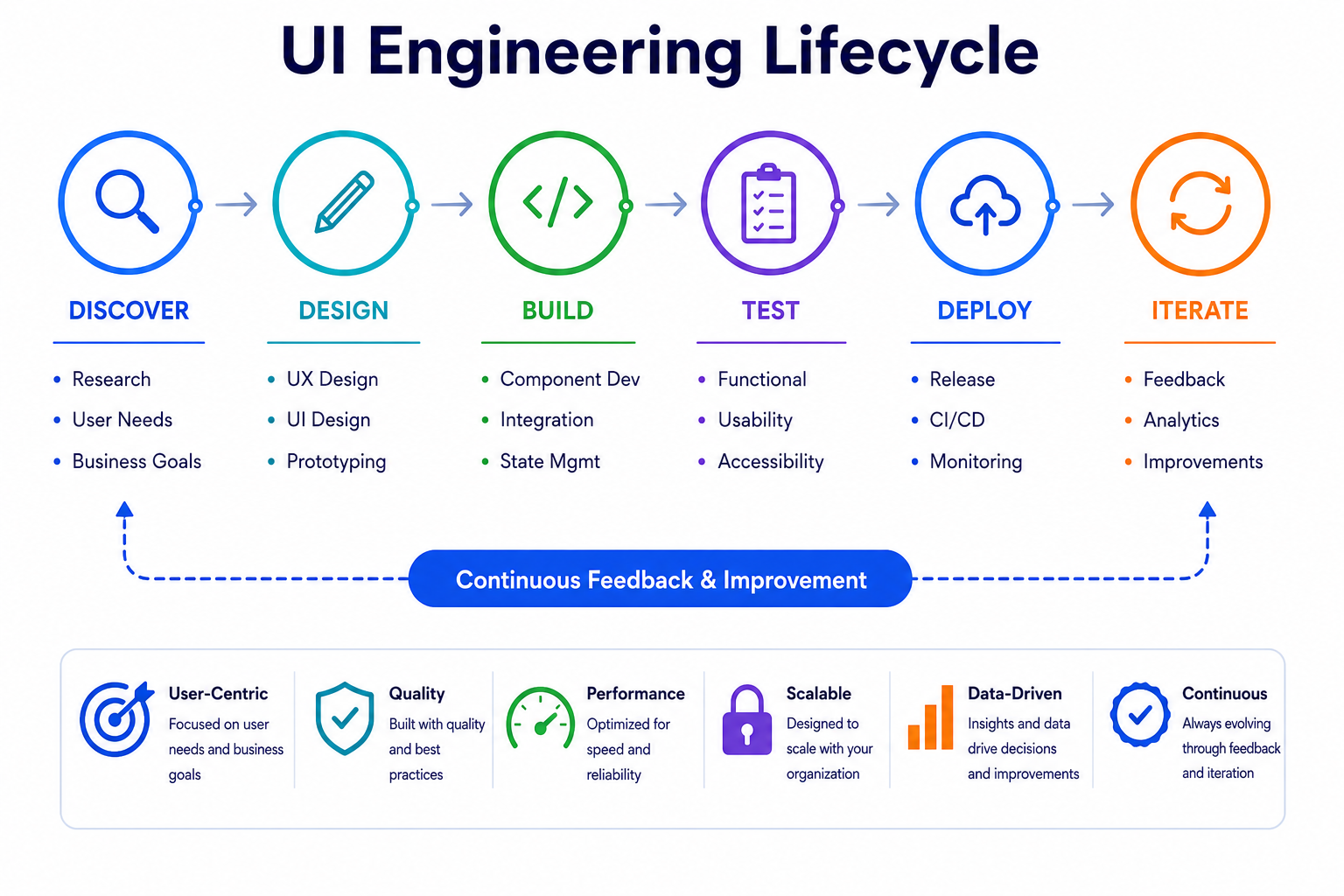
Solve Business Problems
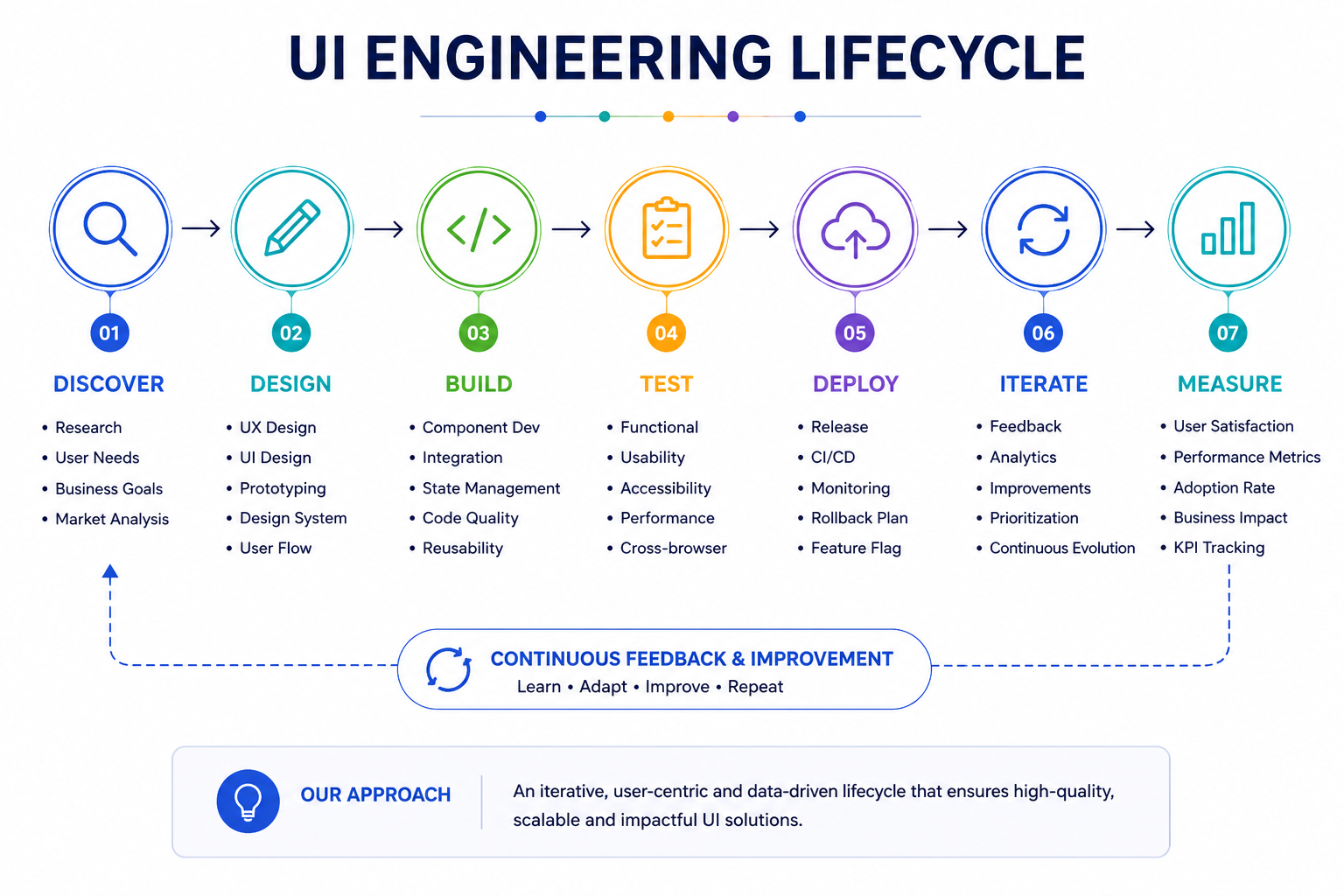
Visual Reference
◆ UI Engineering Lifecycle Diagram
Every feature should address a clearly identified business requirement.
Engineering effort should be invested where it creates measurable operational value.
Simplicity Over Complexity
Business processes may be complex, but the user experience should remain intuitive.
Interfaces should reduce cognitive effort by presenting only the information required to complete a task efficiently.
Platform Thinking
Each ERP module should contribute to a shared platform.
Authentication, permissions, notifications, reporting, configuration, and reusable UI patterns should be common across the product.
Consistency
Users should experience predictable navigation, layouts, workflows, and interactions throughout the application.
Consistency reduces training effort and increases user confidence.
Scalability
Every product decision should support future expansion without requiring significant architectural changes.
The platform should accommodate additional modules, integrations, users, and business workflows while maintaining stability.
Product Lifecycle
The ERP product should follow a structured lifecycle that promotes quality and predictability.
The recommended lifecycle consists of:
1. Business Discovery 2. Requirement Analysis 3. Product Planning 4. UX & UI Design 5. Technical Design 6. Development 7. Quality Assurance 8. User Acceptance Testing 9. Production Release 10. Continuous Improvement
Each stage should have clearly defined ownership, review checkpoints, and measurable deliverables.
Product Roadmap
The roadmap should balance immediate customer needs with long-term platform investments.
Key focus areas include:
Core business capabilities
Platform improvements
User experience enhancements
Performance optimization
Security improvements
Technical debt reduction
Automation initiatives
Engineering productivity
Roadmap decisions should be reviewed periodically to ensure continued alignment with business priorities.
Feature Prioritization
Every feature request should be evaluated using a structured decision framework.
Key evaluation criteria include:
Business impact
Customer value
Engineering effort
Technical dependencies
Operational risk
Strategic alignment
Long-term maintainability
This approach ensures engineering capacity is allocated to initiatives with the highest overall value.
Product Governance
Effective product governance requires collaboration across multiple disciplines.
Responsibilities should be shared between:
Business Stakeholders
Product Management
UX & UI Design
Frontend Engineering
Backend Engineering
Quality Assurance
DevOps
Cross-functional planning improves decision quality while reducing delivery risk.
Success Metrics
Product success should be measured through meaningful indicators rather than feature counts.
Representative metrics include:
User adoption
Feature utilization
Release predictability
Customer feedback
Product stability
Performance benchmarks
Defect trends
Engineering velocity
These indicators provide continuous insight into product health and delivery effectiveness.
Engineering Recommendations
Immediate Priorities
Establish a structured product discovery process.
Standardize product planning and prioritization.
Improve collaboration between Product, Design, and Engineering.
Medium-term Priorities
Strengthen roadmap governance.
Improve customer feedback integration.
Standardize product success metrics.
Long-term Priorities
Build a product-led engineering culture.
Continuously optimize platform capabilities.
Align product investments with long-term business strategy.
Leadership Perspective
A product roadmap should communicate more than planned features.
It should express a long-term vision, establish clear priorities, and create alignment between business strategy and engineering execution.
Leadership is demonstrated by making deliberate product decisions that strengthen the platform while delivering measurable customer value.
Key Takeaways
Product strategy should support business strategy.
Customer value should guide feature prioritization.
Platform thinking improves long-term scalability.
Product governance reduces delivery risk.
Success should be measured through outcomes, not feature count.
A successful ERP product is built through disciplined planning, thoughtful prioritization, and continuous collaboration.
A clear product strategy enables engineering teams to focus on delivering meaningful business outcomes while maintaining architectural integrity, operational stability, and long-term scalability.
The next chapter introduces the UI Engineering Vision, defining how frontend engineering supports product strategy through reusable architecture, standardized development practices, and engineering excellence.
04
Chapter 04
UI Engineering Vision
Vision Context
Modern UI Engineering is not about building screens. It is about building a scalable engineering platform that enables exceptional user experiences, consistent product delivery, and sustainable business growth.
Common engineering standards across every ERP module.
02Reuse
Shared platform assets that reduce duplication and accelerate delivery.
03Scale
Architecture, performance, and quality built for long-term growth.
Executive Context
In enterprise software, the frontend is no longer a presentation layer. It is the primary interface through which users interact with business processes, make operational decisions, and measure organizational performance.
Every business transaction, approval workflow, dashboard, report, and operational activity ultimately depends on the quality of the user experience.
For this reason, UI Engineering should be viewed as a strategic engineering discipline that combines product thinking, architecture, design systems, engineering standards, and delivery excellence.
The goal is not simply to develop interfaces, but to build a frontend platform that enables business growth through consistency, scalability, and engineering discipline.
Strategic Vision
Establish a modern UI Engineering organization capable of delivering scalable, maintainable, and high-performance enterprise applications through standardized engineering practices and reusable platform capabilities.
The frontend should become a shared engineering platform that enables product teams to innovate rapidly while maintaining consistency, reliability, and long-term maintainability.
Business Objectives
The UI Engineering strategy should enable the organization to:
Standardize frontend engineering practices.
Improve development productivity.
Increase component reuse.
Deliver consistent user experiences.
Strengthen application performance.
Improve maintainability.
Reduce technical debt.
Build a scalable frontend platform.
Engineering Mission
The mission of the UI Engineering organization is to create a frontend ecosystem that allows engineering teams to build enterprise products efficiently without compromising architecture, usability, accessibility, or code quality.
The engineering platform should enable every team to focus on solving business problems instead of repeatedly solving engineering problems.
Strategic Objectives
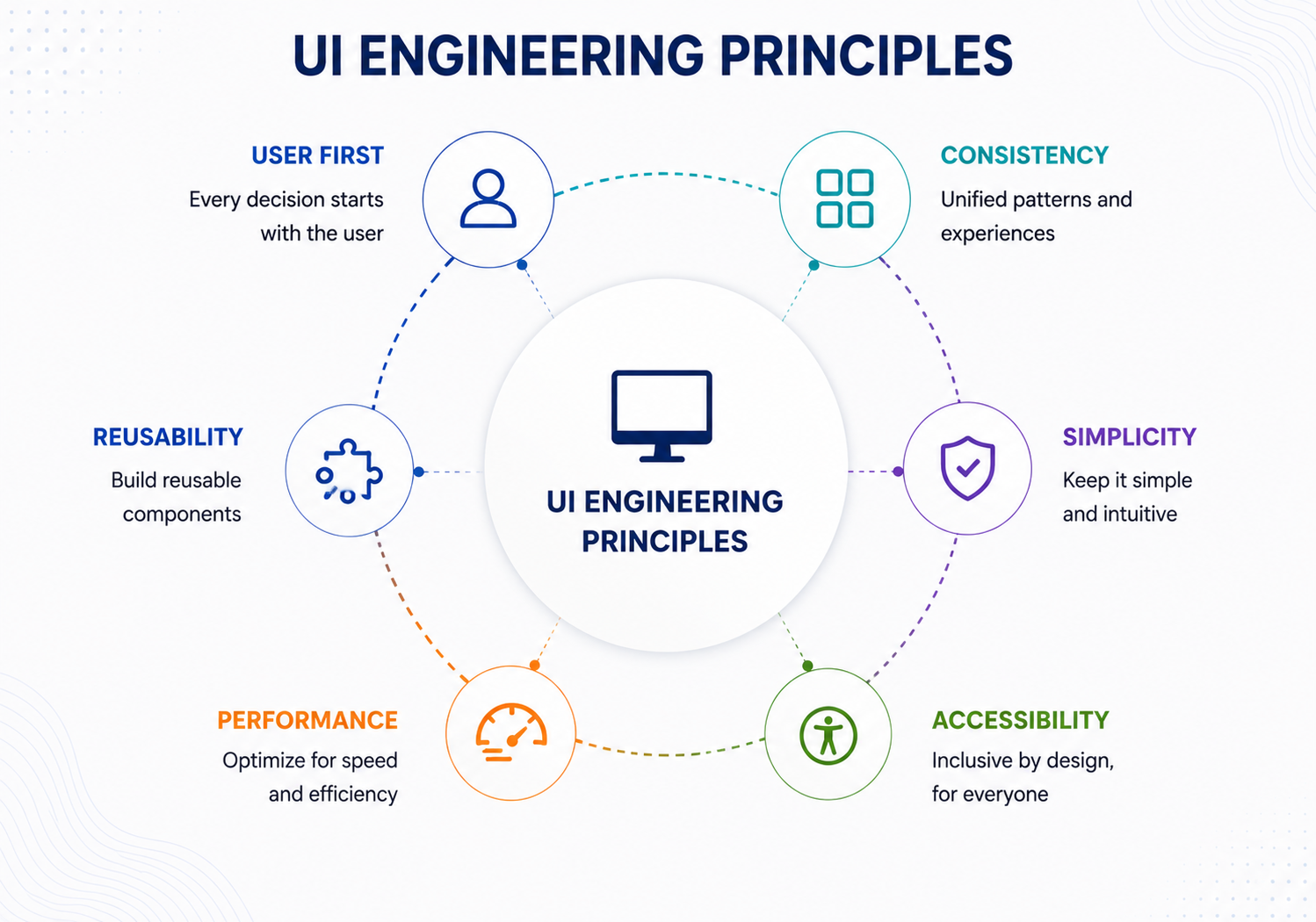
The UI Engineering strategy is built around the following objectives.
Standardization
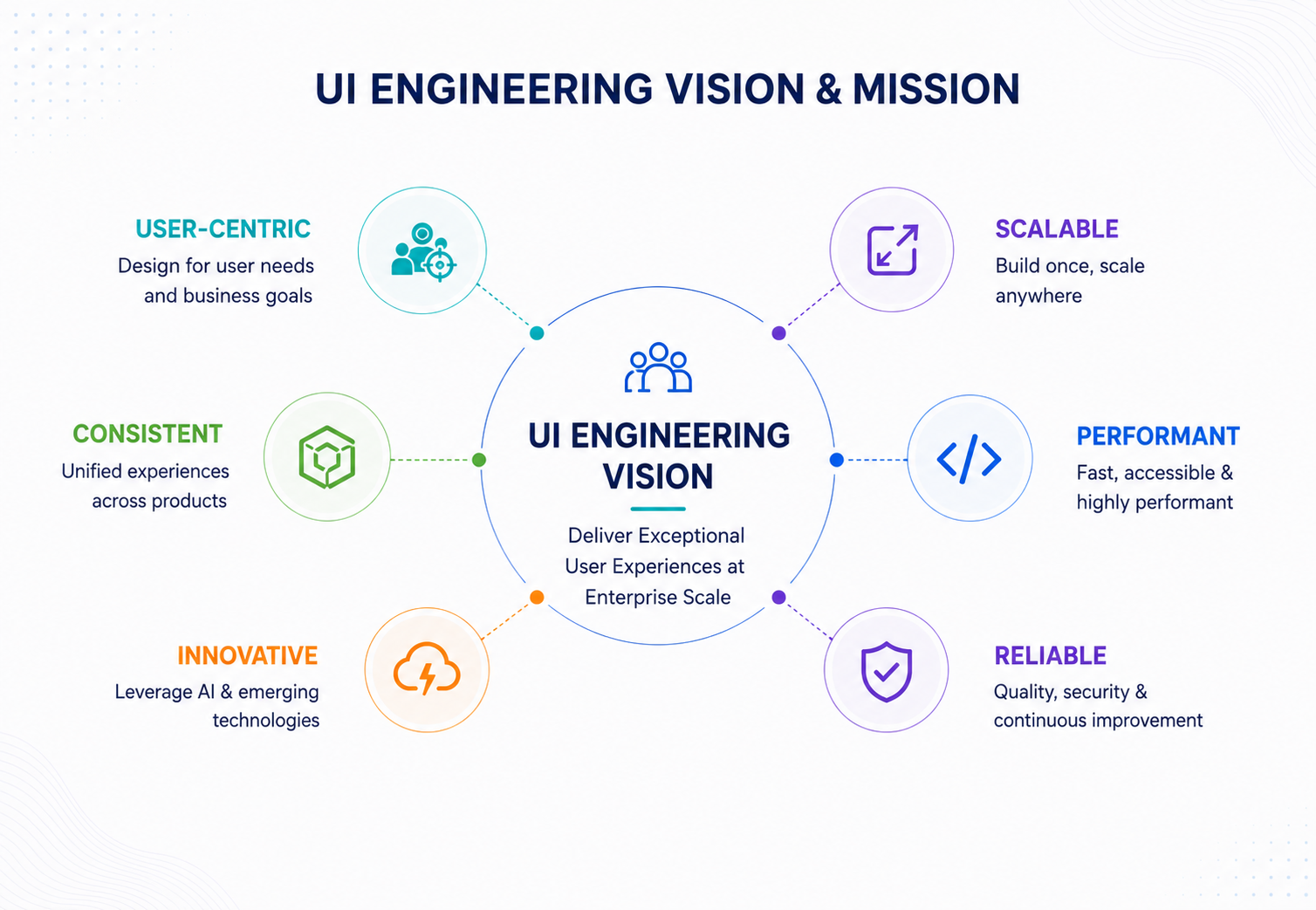
Visual Reference
◆ UI Engineering Vision Diagram
Visual Reference
◆ UI Engineering Principles Infographic
Create common engineering standards that ensure every ERP module follows consistent development practices.
Scalability
Design frontend architecture capable of supporting future products, additional engineering teams, and growing customer requirements.
Reusability
Invest continuously in reusable engineering assets that reduce duplication and improve delivery efficiency.
Maintainability
Ensure applications remain easy to understand, extend, test, and support throughout their lifecycle.
Performance
Deliver responsive enterprise applications that remain reliable under increasing business demand.
Developer Experience
Provide engineering teams with tools, documentation, reusable libraries, and standardized workflows that simplify day-to-day development.
Core Engineering Principles
Every engineering decision should align with the following principles.
Build Once. Reuse Everywhere.
Reusable engineering assets should always be preferred over feature-specific implementations.
Consistency Builds Trust.
Users should experience predictable workflows across every ERP module.
Engineering teams should experience consistent development standards across every project.
Simplicity Drives Maintainability.
Simple solutions remain easier to extend, test, review, and support.
Complexity should only be introduced when it creates measurable business value.
Architecture Enables Growth.
Scalable architecture allows organizations to expand products without increasing engineering complexity.
Quality is Continuous.
Quality should be integrated into planning, development, testing, deployment, and production monitoring.
It should never become the responsibility of a single phase or team.
Engineering Responsibilities
The UI Engineering organization should own the following responsibilities:
Frontend Architecture
Design System Strategy
Enterprise Component Library
Shared Engineering Platform
Engineering Standards
Performance Optimization
Accessibility
Frontend Security
Engineering Documentation
Technical Governance
Developer Experience
Frontend Innovation
Expected Outcomes
A mature UI Engineering organization should consistently deliver:
UI Engineering should not be measured by the number of screens delivered.
Its success should be measured by how effectively it enables product teams to build reliable, scalable, and maintainable enterprise software.
Strong UI Engineering organizations reduce delivery risk, improve product quality, and establish the engineering foundations required for sustainable business growth.
Key Takeaways
UI Engineering is a strategic engineering capability.
Standardization improves scalability and consistency.
Frontend architecture is a long-term business investment.
Chapter Summary
Modern frontend engineering extends far beyond interface development.
It establishes the engineering platform upon which product quality, user experience, developer productivity, and business scalability depend.
Organizations that invest in UI Engineering as a strategic capability create products that are easier to evolve, simpler to maintain, and better positioned for long-term success.
The following chapter explores the engineering leadership principles required to build high-performing teams, establish technical ownership, and foster a culture of continuous improvement.
05
Chapter 05
UI Engineering Leadership
Leadership Context
Engineering leadership is measured not by the authority it holds, but by the clarity of its vision, the strength of its teams, and the quality of the engineering culture it creates.
Establish technical vision, standards, and architectural direction.
02Develop
Invest in mentoring, growth, and knowledge sharing.
03Govern
Reviews, metrics, and continuous improvement at scale.
Executive Context
Technology alone does not create successful products.
The long-term success of any engineering organization depends on leadership that establishes technical direction, promotes accountability, develops people, and creates an environment where engineering teams can consistently deliver high-quality software.
In enterprise product organizations, leadership is measured not by the number of features delivered but by the maturity of engineering practices, the quality of technical decisions, and the ability to build teams that continue to perform as the organization grows.
This chapter defines the leadership principles required to build and sustain a high-performing UI Engineering organization.
Strategic Vision
Create an engineering culture where every team member understands the product, takes ownership of outcomes, collaborates openly, and continuously improves both technical and professional capabilities.
Leadership should empower engineers to make informed decisions while maintaining alignment with business objectives and engineering standards.
Business Objectives
Engineering leadership should enable the organization to:
Establish technical direction.
Build a high-performance engineering culture.
Develop future technical leaders.
Improve collaboration across teams.
Strengthen engineering governance.
Increase delivery predictability.
Encourage continuous learning.
Support sustainable product growth.
Leadership Philosophy
Engineering leadership is built upon five fundamental responsibilities.
Provide Technical Direction
Engineering teams require a clear technical vision.
Leaders should establish architectural direction, define engineering standards, evaluate technical trade-offs, and ensure that technology decisions support long-term product goals rather than short-term implementation convenience.
Build Engineering Culture
Culture influences engineering quality more than process alone.
A healthy engineering culture encourages:
Ownership
Accountability
Transparency
Respect
Curiosity
Continuous learning
Constructive feedback
Culture should be demonstrated through daily engineering practices rather than documented policies.
Develop People
An engineering organization grows when its people grow.
Leaders should actively invest in:
Technical mentoring
Career development
Knowledge sharing
Pair programming
Technical reviews
Learning opportunities
The success of leadership should be reflected in the growth of the team rather than individual achievement.
Enable Collaboration
Modern ERP products require close collaboration between Product, Design, Engineering, QA, DevOps, and Business stakeholders.
Leadership should establish communication models that encourage shared ownership, reduce unnecessary dependencies, and improve decision-making across teams.
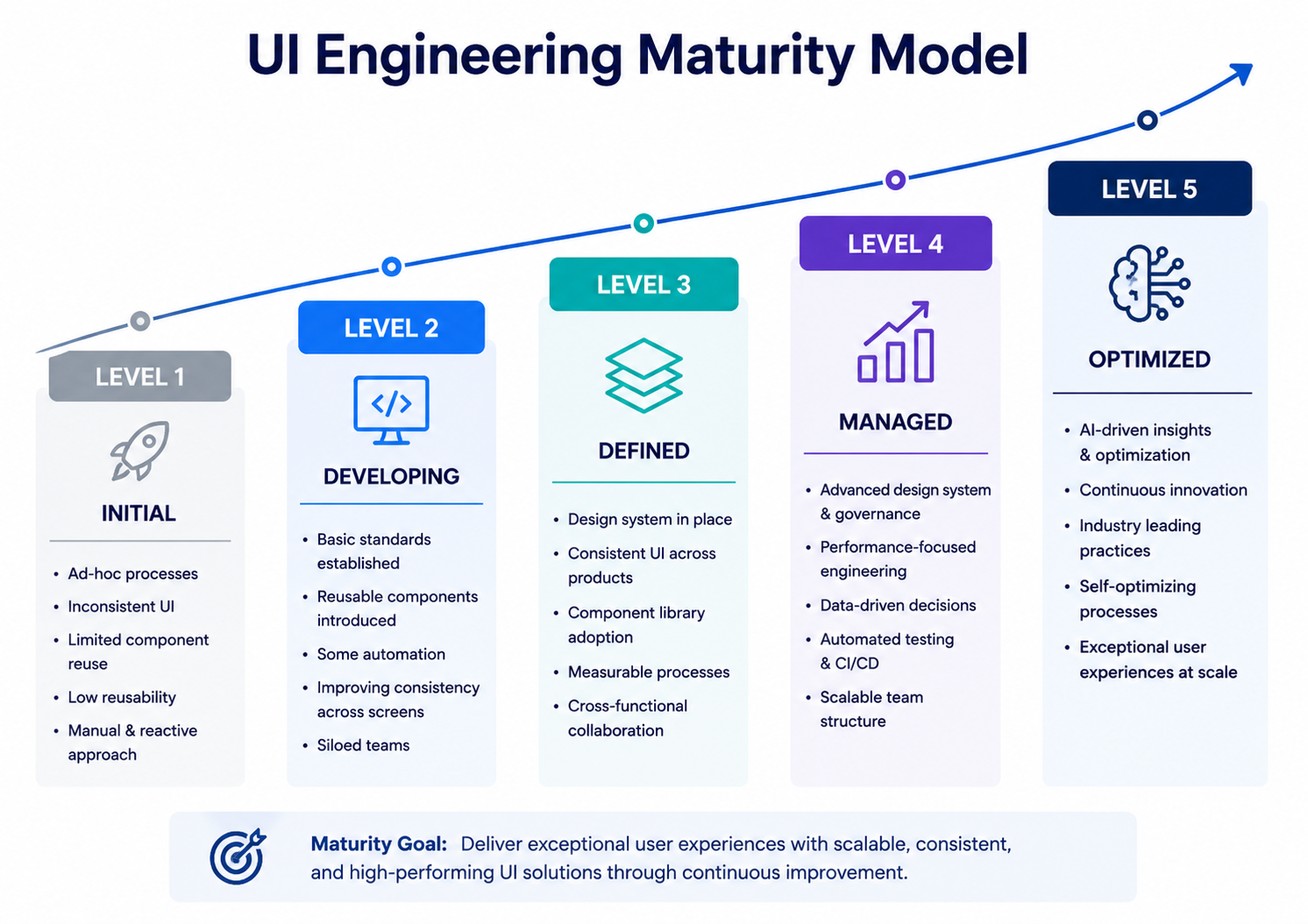
Drive Continuous Improvement
Visual Reference
◆ UI Engineering Maturity Model
Engineering maturity is achieved through continuous refinement.
Leaders should regularly review engineering practices, identify opportunities for improvement, and encourage experimentation where it provides measurable value.
Improvement should become part of normal engineering operations rather than an occasional initiative.
Decision-Making Principles
Engineering decisions should consistently demonstrate the following characteristics:
Business aligned
Data informed
Technically sustainable
Easy to maintain
Well documented
Consistent across teams
Scalable for future growth
Complexity should never become the default solution.
Building High-Performance Teams
High-performing engineering teams are built through trust, clarity, and shared responsibility.
Characteristics of such teams include:
Clear ownership
Shared engineering standards
Open communication
Reliable delivery
Continuous feedback
Knowledge sharing
Mutual respect
Focus on customer value
Leadership should remove obstacles that prevent engineers from delivering their best work.
Mentoring Framework
Mentorship should become an ongoing engineering practice rather than an occasional activity.
Recommended areas of mentorship include:
System Design
Architecture Thinking
Code Quality
Problem Solving
Communication
Product Thinking
Engineering Best Practices
The objective is to prepare engineers for future leadership responsibilities while strengthening overall team capability.
Engineering Governance
Strong leadership requires consistent governance.
Engineering governance should include:
Architecture Reviews
Design Discussions
Code Reviews
Technical Documentation
Sprint Reviews
Retrospectives
Engineering Metrics
Technical Roadmap Reviews
Governance creates consistency while preserving engineering autonomy.
Success Metrics
Leadership effectiveness should be evaluated using measurable outcomes.
Representative indicators include:
Engineering productivity
Delivery predictability
Code quality
Production stability
Team engagement
Knowledge sharing
Developer retention
Customer satisfaction
These indicators provide insight into both technical execution and organizational maturity.
Engineering Recommendations
Immediate Priorities
Establish engineering ownership across teams.
Define leadership responsibilities.
Standardize engineering reviews.
Strengthen technical communication.
Medium-term Priorities
Build structured mentoring programs.
Improve engineering governance.
Expand knowledge-sharing initiatives.
Develop future technical leaders.
Long-term Priorities
Establish a leadership development framework.
Continuously improve engineering culture.
Build succession planning for key technical roles.
Measure leadership effectiveness using engineering outcomes.
Leadership Perspective
Engineering leadership is not defined by authority or hierarchy.
It is demonstrated through technical credibility, thoughtful decision-making, continuous mentoring, and the ability to create an environment where engineering teams consistently succeed.
Organizations that invest in leadership build engineering cultures capable of sustaining product growth for many years.
Key Takeaways
Leadership establishes engineering direction.
Culture influences engineering quality.
Mentoring strengthens organizational capability.
Collaboration improves execution.
Governance enables consistency.
Continuous improvement sustains long-term growth.
Chapter Summary
Successful engineering organizations are built through disciplined leadership rather than individual technical excellence.
By combining clear technical direction, strong engineering culture, structured governance, and continuous people development, organizations create teams capable of delivering scalable, maintainable, and high-quality enterprise software.
The following chapter describes how these leadership principles translate into a structured UI Engineering Organization with clearly defined roles, ownership, collaboration models, and operational responsibilities.
06
Chapter 06
UI Engineering Organization
Organizational Context
Scalable products are built by scalable organizations. Clear ownership, disciplined collaboration, and consistent engineering practices enable teams to deliver sustainable business value.
Chapter Highlights
8Business Objectives4Organizational Principles6Core Team Roles
Strategic Pillars
01Own
Clear ownership for every feature, module, and decision.
02Collaborate
Intentional cross-functional communication and shared goals.
03Standardize
Common practices that create consistency across teams.
Executive Context
As enterprise products evolve, engineering success depends less on individual contributors and more on the effectiveness of the engineering organization.
A scalable ERP platform cannot rely on informal communication, undefined ownership, or isolated technical decisions. Sustainable product development requires a structured engineering organization where responsibilities are clearly defined, collaboration is intentional, and engineering standards are consistently applied.
The purpose of this chapter is to define an organizational model that enables engineering teams to deliver high-quality software while supporting long-term product growth.
Strategic Vision
Build a collaborative UI Engineering organization where product thinking, technical excellence, and operational discipline work together to deliver scalable enterprise software.
Every engineer should understand not only what to build, but why it matters, who owns it, and how it contributes to the overall product strategy.
Business Objectives
The UI Engineering organization should enable the business to:
Establish clear engineering ownership.
Improve cross-functional collaboration.
Standardize engineering practices.
Increase delivery predictability.
Strengthen technical governance.
Improve engineering productivity.
Accelerate onboarding.
Support sustainable product growth.
Organizational Principles
The engineering organization should operate according to the following principles.
Clear Ownership
Every feature, module, and engineering decision should have a clearly identified owner.
Ownership improves accountability, reduces ambiguity, and accelerates decision-making.
Shared Responsibility
While ownership belongs to individuals or teams, product success remains a shared responsibility.
Architecture, quality, security, and customer experience should be considered collective objectives rather than isolated responsibilities.
Standardization
Common engineering practices create consistency across teams.
The objective is to optimize product outcomes rather than departmental efficiency.
Engineering Organization Structure
A structured UI Engineering organization should define clear technical responsibilities across multiple roles.
Frontend Architect
Provides long-term architectural direction, establishes engineering standards, evaluates technologies, and ensures consistency across the platform.
Engineering Lead
Coordinates technical execution, mentors engineers, reviews architecture decisions, manages sprint execution, and aligns engineering activities with product priorities.
Senior Frontend Engineer
Leads implementation of complex features, supports code reviews, improves reusable components, and mentors junior engineers.
Frontend Engineer
Develops business features, contributes to shared libraries, fixes defects, writes tests, and participates in sprint delivery.
UX Designer
Defines interaction patterns, user journeys, accessibility requirements, and maintains visual consistency across the platform.
Quality Engineer
Owns functional validation, regression testing, release verification, and quality reporting.
Ownership Model
Ownership should extend beyond implementation.
Every engineering owner should remain responsible for:
Feature Planning
Technical Design
Development
Code Quality
Documentation
Testing Support
Release Readiness
Production Support
Continuous Improvement
This lifecycle ownership encourages better technical decisions and stronger accountability.
Communication Framework
Effective communication is essential for predictable engineering execution.
The organization should establish regular forums for:
Sprint Planning
Daily Stand-ups
Technical Design Reviews
Architecture Discussions
Sprint Reviews
Retrospectives
Knowledge Sharing Sessions
Each meeting should have a clearly defined purpose and expected outcome.
Engineering Governance
Governance ensures that engineering quality remains consistent as teams grow.
Recommended governance activities include:
Architecture Reviews
Code Reviews
Engineering Audits
Documentation Reviews
Performance Assessments
Security Reviews
Technical Roadmap Reviews
Governance should enable better engineering decisions without creating unnecessary process overhead.
Knowledge Management
Engineering knowledge should become an organizational asset.
Recommended practices include:
Technical Documentation
Architecture Decision Records (ADR)
Engineering Playbooks
Internal Workshops
Pair Programming
Brown Bag Sessions
Post-Incident Reviews
Documenting decisions helps future teams understand not only what was built, but why it was built that way.
Success Metrics
A mature engineering organization should continuously improve the following indicators:
Delivery Predictability
Code Quality
Engineering Productivity
Component Reuse
Release Stability
Developer Onboarding Time
Cross-Team Collaboration
Customer Satisfaction
These metrics provide visibility into organizational effectiveness and engineering maturity.
Engineering Recommendations
Immediate Priorities
Define engineering ownership for every product area.
Standardize team responsibilities.
Establish communication and review processes.
Improve engineering documentation.
Medium-term Priorities
Strengthen cross-functional collaboration.
Improve onboarding processes.
Expand knowledge-sharing initiatives.
Standardize governance practices.
Long-term Priorities
Build a scalable engineering organization.
Continuously improve organizational maturity.
Strengthen leadership development.
Measure organizational effectiveness through engineering metrics.
Leadership Perspective
Engineering organizations become scalable when responsibilities are clear, collaboration is intentional, and engineering practices are standardized.
Leadership should focus on creating systems that allow teams to make consistent decisions, share knowledge effectively, and deliver reliable software with confidence.
The goal is not to build dependency on individuals, but to build an organization capable of sustained execution.
Key Takeaways
Organizational clarity improves execution.
Ownership creates accountability.
Collaboration reduces delivery risk.
Governance strengthens engineering quality.
Knowledge sharing accelerates team growth.
Engineering maturity is built through consistent practices.
Chapter Summary
A successful UI Engineering organization is built on structured ownership, disciplined governance, collaborative execution, and continuous learning.
By investing in organizational design as carefully as technical architecture, engineering leaders create teams capable of delivering scalable, maintainable, and high-quality enterprise software that supports long-term business success.
The following chapter introduces the Enterprise Frontend Architecture that provides the technical foundation for every engineering decision described in this blueprint.
07
Chapter 07
Enterprise Frontend Architecture
Architecture Context
Architecture is a long-term business investment. Well-designed systems enable organizations to innovate faster, scale confidently, and deliver consistent value over time.
Independent modules that support parallel development.
02Reusable
Shared platform capabilities across every business module.
03Scalable
Architecture built for growth, stability, and maintainability.
Executive Context
Enterprise Frontend Architecture is the foundation upon which product quality, engineering productivity, scalability, and long-term maintainability are built.
While frontend technologies continue to evolve, the principles of good architecture remain remarkably consistent.
Successful architecture is not determined by the framework being used. It is determined by how effectively the system supports product evolution, engineering collaboration, operational stability, and business growth.
An ERP platform is expected to evolve continuously over many years.
New business modules, additional engineering teams, changing customer expectations, third-party integrations, and increasing operational complexity all place continuous pressure on the frontend architecture.
Without a structured architectural foundation, engineering teams gradually accumulate technical debt, duplicated implementations, inconsistent user experiences, and unpredictable delivery cycles.
This chapter defines the architectural principles that should guide every engineering decision throughout the lifecycle of the ERP platform.
Strategic Vision
Create a unified frontend platform that enables multiple engineering teams to develop enterprise applications using shared engineering standards, reusable platform capabilities, and consistent architectural practices.
The architecture should remain flexible enough to support future business expansion while maintaining engineering simplicity and operational stability.
Every architectural decision should improve the platform rather than increasing its complexity.
Business Objectives
The architecture should enable the organization to:
Standardize frontend engineering.
Improve engineering productivity.
Increase platform reusability.
Simplify onboarding.
Support parallel development.
Reduce technical debt.
Improve software quality.
Enable sustainable product growth.
What Enterprise Architecture Means
Enterprise Frontend Architecture is not simply the organization of source code.
It is a structured engineering system that defines:
How applications are built.
How teams collaborate.
How business modules communicate.
How engineering standards are enforced.
How reusable capabilities are shared.
How the platform evolves over time.
Architecture therefore becomes an organizational capability rather than an implementation detail.
Strategic Objectives
The architecture should enable the organization to achieve the following objectives:
Standardize frontend engineering across all ERP modules.
Reduce implementation complexity.
Increase component reuse.
Improve engineering productivity.
Simplify onboarding of new engineers.
Support parallel development by multiple teams.
Enable predictable software delivery.
Maintain long-term product scalability.
Reduce technical debt.
Improve overall engineering quality.
Core Architectural Principles
Every architectural decision should be evaluated against a common set of engineering principles.
Business Alignment
Architecture exists to support business objectives.
Technical decisions should simplify future product development while enabling rapid response to changing business requirements.
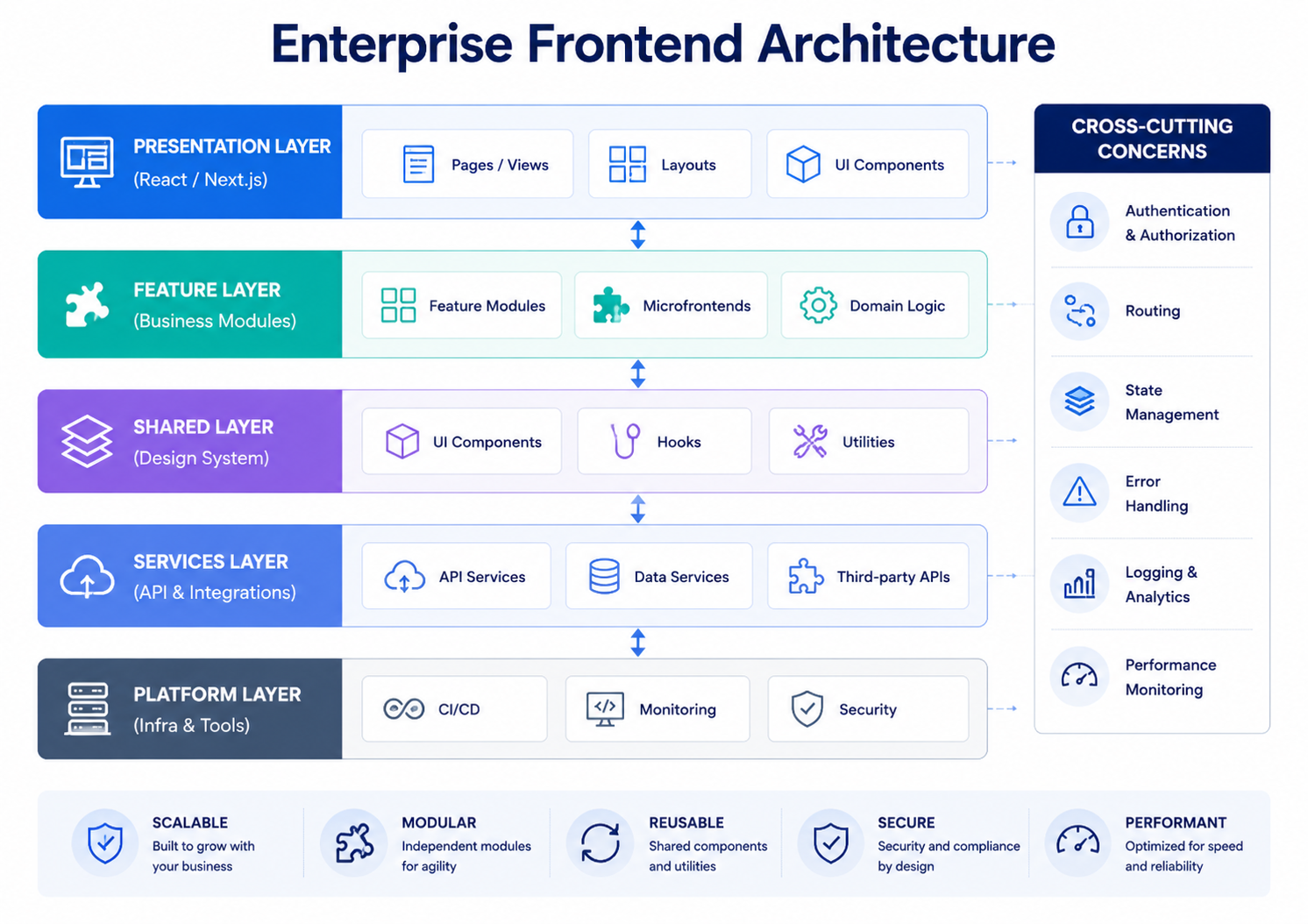
Modularity
Visual Reference
◆ Enterprise Frontend Architecture Diagram
Business capabilities should be organized into independent modules with clearly defined responsibilities.
Modules should collaborate through stable contracts rather than direct implementation dependencies.
This approach enables engineering teams to work independently while preserving platform consistency.
Reusability
Reusable engineering assets should become the default implementation strategy.
Whenever functionality is repeated across multiple business modules, it should be extracted into a shared platform capability.
Examples include:
Authentication
Authorization
Notifications
Form Components
Data Tables
Validation
Logging
API Client
Layout Framework
Theme Configuration
Platform investment reduces duplication while improving consistency across the ERP ecosystem.
Consistency
Consistency improves both user experience and engineering productivity.
The following should remain standardized across every application:
User Interface
Navigation
Component Behaviour
Folder Structure
Coding Standards
API Patterns
Error Handling
Testing Strategy
Documentation
Consistency reduces cognitive load for both users and engineers.
Simplicity
Complex systems should be designed through simple building blocks.
Architectural simplicity improves maintainability, onboarding, debugging, and future enhancement.
Complexity should only be introduced where it delivers measurable business value.
Scalability
The architecture should support future expansion without major redesign.
Scalability should consider:
Additional ERP modules
Larger engineering teams
Multiple customer deployments
Increased business workflows
Platform integrations
Future technology evolution
Maintainability
Every architectural decision should simplify future engineering work.
Readable code, modular design, clear documentation, and standardized implementation patterns reduce maintenance effort while improving engineering confidence.
Maintainability should be treated as a first-class engineering objective rather than a post-release concern.
Engineering Recommendations
Immediate Priorities
Define enterprise architecture standards.
Standardize project structure.
Introduce reusable platform capabilities.
Establish architecture review processes.
Medium-term Priorities
Expand the shared engineering platform.
Improve architectural documentation.
Strengthen module independence.
Standardize integration patterns.
Long-term Priorities
Build a scalable platform architecture.
Continuously reduce technical debt.
Improve architectural governance.
Evolve the platform based on business growth and technology advancements.
Leadership Perspective
Architecture is one of the few engineering investments whose value increases over time.
Well-designed architecture enables teams to move faster, collaborate more effectively, and evolve products with confidence.
Poor architecture has the opposite effect—it slows delivery, increases operational risk, and gradually limits product innovation.
Engineering leaders therefore have a responsibility to protect architectural integrity while continuously adapting the platform to changing business needs.
Key Takeaways
Architecture is a long-term business investment.
Modularity enables independent product evolution.
Reusability improves engineering efficiency.
Consistency strengthens engineering quality and user experience.
Simplicity reduces long-term maintenance costs.
Scalability should be designed from the beginning.
Maintainability determines the long-term health of the platform.
Chapter Summary
Enterprise Frontend Architecture provides the strategic engineering foundation for the ERP platform.
By emphasizing modularity, consistency, scalability, and reusability, the organization creates a frontend ecosystem capable of supporting long-term product evolution while maintaining engineering quality and delivery predictability.
The next chapter introduces the Design System Strategy, defining how a standardized design language, reusable UI components, and consistent user experiences strengthen both product quality and engineering efficiency.
08
Chapter 08
Design System Strategy
Design System Context
A Design System is the operational foundation of modern product development. It creates a shared language between Design, Product, and Engineering, enabling consistent user experiences and predictable software delivery.
Predictable layouts, patterns, and workflows across modules.
02Reusable
Tokens, components, and patterns as the default strategy.
03Accessible
Inclusive design integrated into every interface decision.
Executive Context
As enterprise applications expand, maintaining consistency across products becomes increasingly challenging. Independent implementation of interface elements often results in inconsistent user experiences, duplicated engineering effort, accessibility gaps, and higher maintenance costs.
A Design System addresses these challenges by establishing a unified foundation for visual design, interaction patterns, reusable components, and engineering standards.
Rather than viewing the Design System as a collection of UI components, it should be treated as a strategic platform that enables scalable product development across the organization.
Strategic Vision
Establish a Design System that serves as the single source of truth for interface design, frontend engineering, accessibility, and interaction standards across the ERP platform.
The Design System should accelerate product delivery while ensuring every application delivers a consistent, intuitive, and reliable user experience.
Business Objectives
A mature Design System should support the following objectives:
Improve product consistency.
Increase engineering productivity.
Reduce duplicate implementation.
Strengthen accessibility.
Simplify maintenance.
Accelerate feature delivery.
Improve collaboration between Design and Engineering.
Enable long-term platform scalability.
Design Principles
The Design System should evolve according to a common set of principles.
Consistency
Users should experience predictable layouts, navigation patterns, controls, and workflows regardless of which ERP module they are using.
Consistency improves usability while reducing the learning curve for new users.
Reusability
Reusable assets should become the default implementation strategy.
Instead of creating project-specific solutions, teams should extend existing components and patterns wherever practical.
Accessibility
Accessibility should be integrated into every design decision.
Components should support keyboard navigation, sufficient color contrast, semantic structure, and assistive technologies.
Accessibility should be treated as a product requirement rather than a compliance exercise.
Scalability
The Design System should evolve with the product.
New modules, workflows, and business capabilities should be supported without introducing unnecessary design variation.
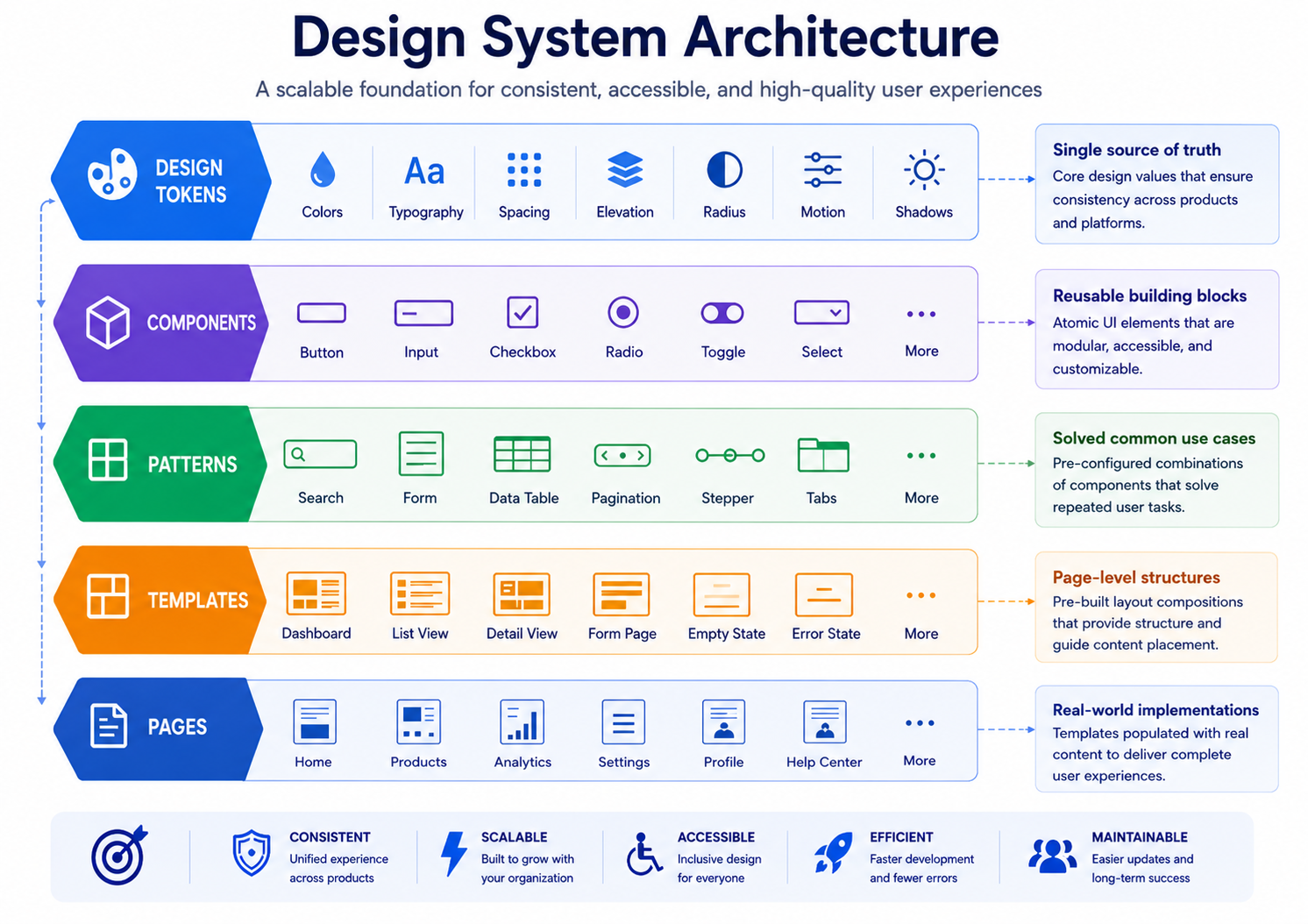
Simplicity
Visual Reference
◆ Design System Architecture Overview
Interfaces should reduce cognitive load by presenting information clearly and consistently.
Simple design decisions often create the best long-term user experience.
Design Foundations
The Design System should define the visual foundations that every application follows.
Core foundations include:
Color System
Typography
Spacing Scale
Grid System
Elevation
Border Radius
Iconography
Motion Guidelines
Responsive Breakpoints
These foundational elements establish visual consistency throughout the platform.
Interaction Patterns
Consistent interaction patterns improve user confidence and reduce training effort.
The Design System should standardize:
Navigation
Search
Forms
Validation
Notifications
Dialogs
Data Tables
Pagination
Empty States
Loading States
Error Handling
Every interaction should behave consistently across all modules.
Component Standards
Every component included within the Design System should satisfy common engineering expectations.
Each component should be:
Reusable
Configurable
Accessible
Responsive
Theme-aware
Performance Optimized
Well Documented
Version Controlled
Independently Tested
Components should expose predictable APIs while hiding implementation complexity.
Documentation Strategy
Documentation is essential for successful adoption.
Each component should include:
Purpose
Usage Guidelines
Available Properties
Accessibility Notes
Implementation Examples
Design References
Best Practices
Common Mistakes
Version History
Well-maintained documentation improves engineering consistency and reduces onboarding effort.
Governance Model
A Design System should be managed as a continuously evolving product.
Recommended governance activities include:
Design Reviews
Component Reviews
Accessibility Audits
Version Management
Change Approval
Contribution Guidelines
Deprecation Planning
Documentation Reviews
Governance ensures stability while supporting continuous improvement.
Measuring Success
The effectiveness of the Design System should be evaluated using measurable indicators.
Representative metrics include:
Component Reuse
Design Consistency
Accessibility Compliance
Development Time
UI Defects
Adoption Rate
Documentation Coverage
Developer Satisfaction
These metrics provide visibility into both engineering efficiency and product quality.
Engineering Recommendations
Immediate Priorities
Establish Design System ownership.
Define design and engineering standards.
Standardize core UI components.
Create comprehensive documentation.
Medium-term Priorities
Expand reusable component coverage.
Improve accessibility compliance.
Strengthen design governance.
Increase Design System adoption across all modules.
Long-term Priorities
Evolve the Design System as a product.
Continuously improve design consistency.
Measure adoption through engineering metrics.
Support future platform scalability through reusable design assets.
Leadership Perspective
A Design System is not simply a design initiative.
It is an organizational capability that enables product teams to work faster while maintaining consistency, quality, and usability.
Organizations that invest in a mature Design System reduce engineering duplication, improve collaboration, and establish a sustainable foundation for long-term product evolution.
Key Takeaways
A Design System is a strategic engineering platform.
Consistency improves both usability and productivity.
Reusability reduces engineering effort.
Accessibility should be integrated from the beginning.
Governance sustains long-term quality.
Documentation accelerates adoption.
Design Systems become more valuable as products scale.
Chapter Summary
A well-governed Design System enables organizations to deliver enterprise applications with greater consistency, efficiency, and confidence.
By combining reusable design foundations, standardized interaction patterns, structured governance, and continuous improvement, engineering teams create products that remain maintainable, scalable, and user-centric throughout their lifecycle.
The following chapter introduces the Enterprise Component Library, explaining how reusable engineering assets are designed, governed, versioned, and continuously improved across the ERP platform.
09
Chapter 09
Enterprise Component Library
Component Library Context
A Component Library is more than a collection of reusable UI elements. It is an engineering platform that standardizes implementation, accelerates product delivery, and preserves consistency across every application.
Production-ready components adopted across every product.
02Compose
Complex interfaces built from smaller building blocks.
03Govern
Documentation, versioning, and quality at platform scale.
Executive Context
As ERP platforms evolve, engineering teams inevitably encounter the same implementation challenges across multiple modules. Forms, tables, search panels, approval workflows, dialogs, dashboards, and reporting interfaces often require similar functionality.
Without a shared engineering platform, these capabilities are repeatedly implemented, resulting in inconsistent behaviour, duplicated effort, increased maintenance costs, and fragmented user experiences.
An Enterprise Component Library addresses this challenge by providing a centralized repository of reusable, production-ready components that can be adopted consistently across every product and engineering team.
Rather than rebuilding common functionality, engineering teams should focus their efforts on solving business problems while relying on standardized platform components.
Strategic Vision
Establish a centralized Component Library that becomes the default engineering foundation for every frontend application.
The library should improve consistency, accelerate development, simplify maintenance, and enable engineering teams to deliver enterprise applications with greater confidence.
Business Objectives
The Component Library should support the following objectives:
Increase engineering productivity.
Reduce duplicate implementation.
Standardize user experience.
Improve software quality.
Accelerate onboarding of new engineers.
Simplify long-term maintenance.
Encourage engineering reuse.
Strengthen delivery consistency.
Engineering Principles
The Component Library should evolve according to a common set of engineering principles.
Reusability
Components should be designed for repeated use across multiple products and business modules.
Implementation effort invested once should continue generating value throughout the platform.
Consistency
Every component should behave predictably regardless of where it is used.
Visual appearance, interaction behaviour, accessibility, validation, and documentation should remain consistent.
Composability
Complex business interfaces should be assembled from smaller reusable building blocks.
Composable architecture simplifies maintenance while improving engineering flexibility.
Extensibility
Components should support future enhancements without requiring breaking changes.
Configuration should be preferred over customization wherever practical.
Reliability
Shared components should meet higher quality standards than feature-specific implementations.
Because they are reused widely, their stability directly influences overall product quality.
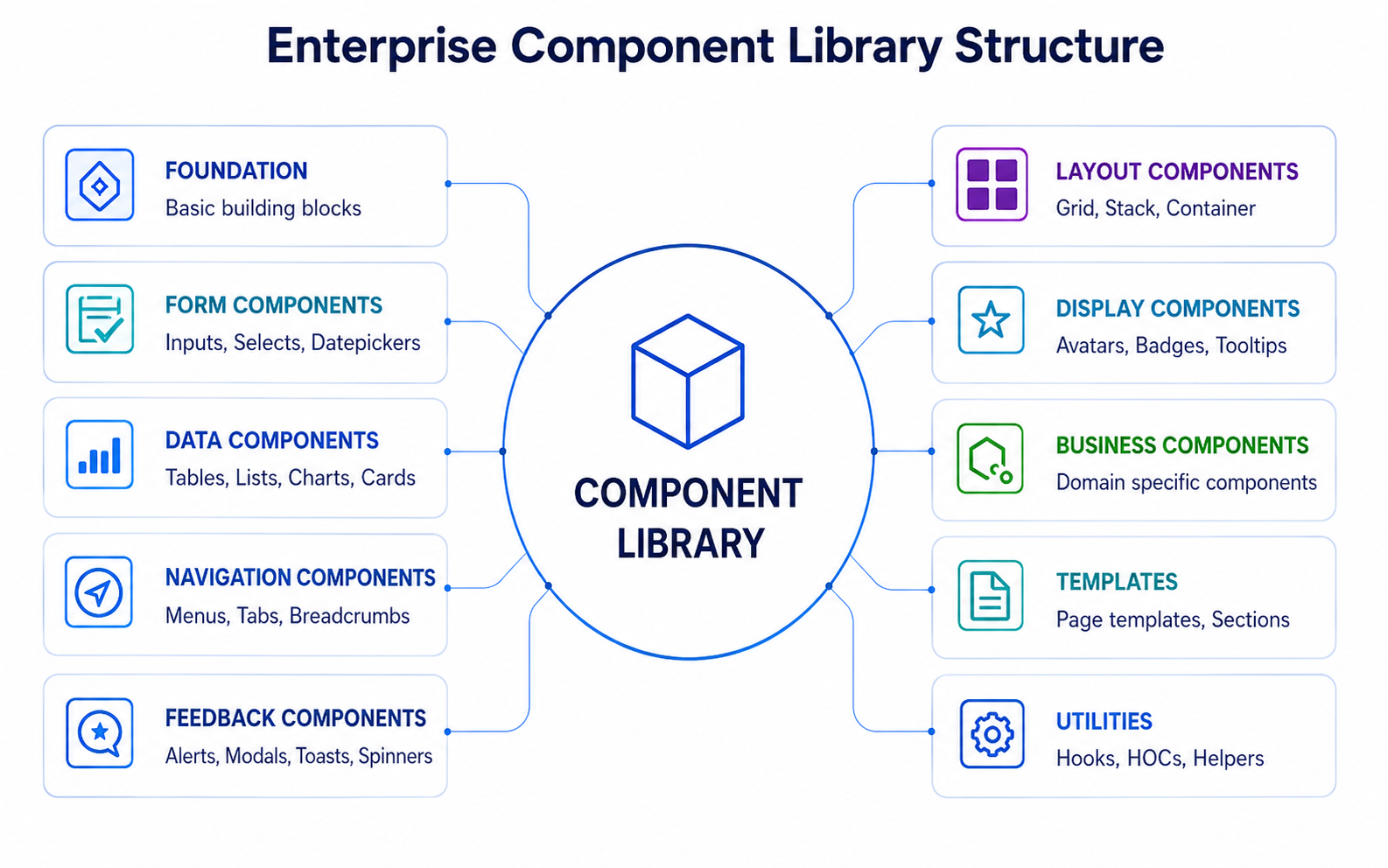
Component Categories
The library should organize components into clearly defined categories.
Foundation Components
Visual Reference
◆ Enterprise Component Library Structure
Basic interface elements used throughout the platform.
Examples include:
Button
Input
Select
Checkbox
Radio Button
Switch
Text Area
Badge
Avatar
Tooltip
Layout Components
Reusable layout structures that establish consistent page composition.
Examples include:
Container
Grid
Stack
Card
Divider
Tabs
Accordion
Sidebar
Drawer
Navigation Components
Navigation should follow common interaction patterns.
Examples include:
Breadcrumb
Menu
Pagination
Stepper
Navigation Rail
Command Bar
Data Components
Business applications rely heavily on structured data presentation.
Examples include:
Data Table
Data Grid
Statistics Cards
Charts
Timeline
Tree View
Progress Indicators
Empty State
Skeleton Loader
Feedback Components
These components communicate application state.
Examples include:
Alert
Toast
Modal
Dialog
Confirmation Panel
Loading Indicator
Success Message
Error State
Enterprise Components
Domain-specific components developed for ERP workflows.
Examples include:
Search Filters
Approval Workflow
Status Badge
Audit Timeline
Attachment Viewer
Activity Feed
User Assignment
Permission Matrix
Business Dashboard Widgets
These components significantly reduce development effort across multiple business modules.
Documentation Standards
Every component should include comprehensive documentation.
Documentation should describe:
Purpose
Usage Guidelines
Properties
Accessibility Behaviour
Design References
Code Examples
Best Practices
Known Limitations
Version History
Documentation should evolve together with component implementation.
Versioning Strategy
The Component Library should follow a structured release process.
Recommended practices include:
Semantic Versioning
Release Notes
Migration Guides
Backward Compatibility
Deprecation Policy
Change Approval Process
Version discipline reduces upgrade risk while improving adoption across multiple projects.
Governance Model
The Component Library should be managed as an engineering product.
Governance responsibilities include:
Component Ownership
Contribution Reviews
Technical Validation
Accessibility Verification
Performance Evaluation
Documentation Review
Release Management
A structured governance model ensures long-term stability and continuous improvement.
Measuring Success
The effectiveness of the Component Library should be evaluated using measurable indicators.
Recommended metrics include:
Component Adoption Rate
Reuse Percentage
Duplicate Component Reduction
Development Time Saved
Documentation Coverage
Accessibility Compliance
UI Defect Trends
Developer Satisfaction
These metrics help evaluate both engineering efficiency and platform maturity.
Engineering Recommendations
Immediate Priorities
Define component ownership.
Standardize core reusable components.
Establish contribution guidelines.
Improve component documentation.
Medium-term Priorities
Expand enterprise component coverage.
Strengthen accessibility and performance validation.
Improve version management.
Increase component adoption across all product teams.
Long-term Priorities
Continuously evolve the Component Library as an engineering platform.
Measure engineering productivity through component reuse.
Strengthen governance and quality standards.
Support future platform scalability through reusable engineering assets.
Leadership Perspective
A mature Component Library represents one of the highest-return engineering investments an organization can make.
As adoption increases, every reusable component reduces implementation effort, improves consistency, strengthens quality, and accelerates future product delivery.
Organizations that continuously invest in shared engineering assets create platforms that become more valuable with every release.
Key Takeaways
A Component Library is an engineering platform, not simply a UI toolkit.
Consistency strengthens both product quality and user experience.
Documentation is essential for successful adoption.
Governance protects long-term platform stability.
Shared engineering assets reduce technical debt and delivery effort.
Chapter Summary
An Enterprise Component Library provides the reusable engineering foundation required to build scalable ERP applications efficiently.
By combining standardized implementation, disciplined governance, comprehensive documentation, and continuous improvement, engineering organizations create a platform that accelerates development while preserving consistency, quality, and long-term maintainability.
The following chapter defines the Engineering Standards that guide how software is structured, reviewed, documented, tested, and maintained across the organization.
10
Chapter 10
UI Engineering Standards
Standards Context
Engineering standards are not created to restrict developers. They exist to create consistency, reduce unnecessary complexity, and enable teams to deliver reliable software at scale.
Common patterns, structures, and naming across repositories.
02Readable
Code that is easy to review, extend, and maintain.
03Reliable
Quality, testing, and documentation built into every delivery.
Executive Context
As engineering teams grow, differences in coding style, architectural decisions, project structure, and development practices gradually increase operational complexity.
Without shared standards, software becomes difficult to review, extend, test, and maintain.
Engineering standards provide a common language for the organization. They establish clear expectations for how software is designed, implemented, reviewed, tested, documented, and maintained throughout its lifecycle.
The objective is to improve consistency without limiting engineering creativity.
Strategic Vision
Establish a unified engineering framework that enables every team to build software using the same principles, development practices, and quality expectations.
The standards should simplify collaboration, improve maintainability, and reduce delivery risk while allowing teams to innovate within clearly defined architectural boundaries.
Business Objectives
Engineering standards should enable the organization to:
Standardize engineering practices.
Improve software quality.
Reduce implementation inconsistency.
Strengthen engineering collaboration.
Improve maintainability.
Accelerate onboarding.
Reduce delivery risk.
Support long-term platform scalability.
Core Engineering Principles
Every engineering decision should align with the following principles.
Simplicity
Solutions should remain easy to understand, review, and maintain.
Simple systems are more resilient and easier to evolve.
Consistency
Projects should follow common implementation patterns.
A developer moving between repositories should encounter familiar folder structures, naming conventions, and engineering practices.
Readability
Code is written once but read many times.
Readable code improves collaboration, reduces defects, and simplifies onboarding.
Reusability
Reusable utilities, shared services, and common components should always be preferred over duplicate implementations.
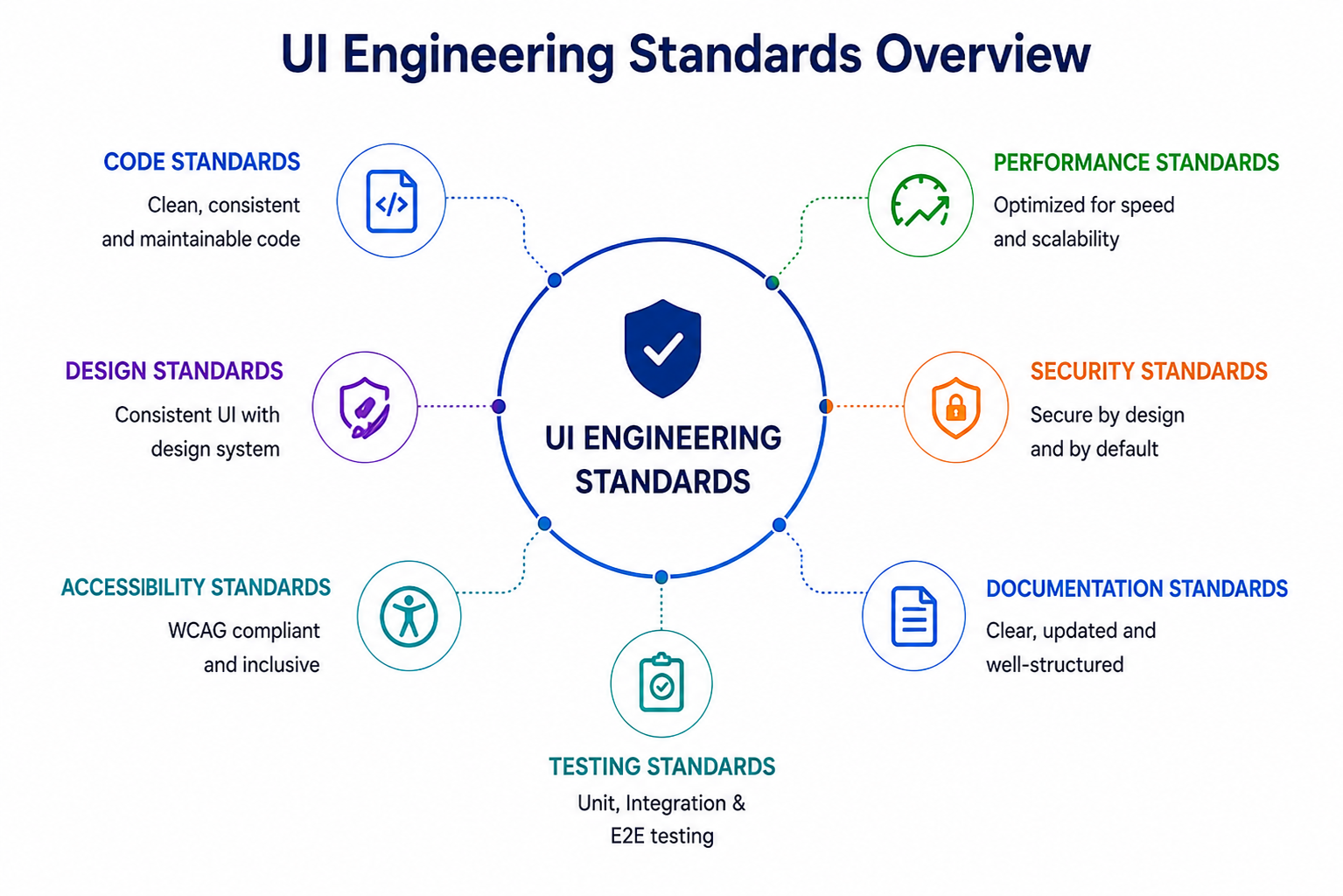
Maintainability
Visual Reference
◆ UI Engineering Standards Overview
Every implementation should reduce future maintenance effort rather than increase it.
Engineering decisions should consider the long-term health of the platform.
Project Structure
Every frontend application should follow a predictable project organization.
A consistent structure improves discoverability and reduces onboarding time.
Typical project organization should separate:
Application
Features
Shared Components
Services
Hooks
Utilities
Assets
Types
Configuration
Tests
Documentation
The structure should remain stable across all ERP modules.
Naming Conventions
Naming should communicate intent clearly.
Recommended conventions include:
Meaningful component names
Descriptive function names
Domain-oriented folder names
Consistent API naming
Standardized file naming
Clear naming reduces ambiguity and improves long-term maintainability.
Code Review Standards
Code review is an engineering quality activity, not an approval process.
Every review should evaluate:
Business correctness
Architectural alignment
Readability
Performance
Security considerations
Reusability
Test coverage
Documentation updates
Feedback should be constructive, specific, and focused on improving the overall quality of the product.
Documentation Standards
Engineering documentation should evolve together with the codebase.
Documentation should exist for:
Architecture Decisions
Module Design
API Contracts
Shared Components
Development Setup
Deployment Process
Operational Runbooks
Well-maintained documentation reduces dependency on individual engineers.
Git Workflow
Version control should support disciplined collaboration.
Recommended practices include:
Short-lived feature branches
Meaningful commit messages
Pull Request reviews
Protected main branch
Release tagging
Clear branching strategy
A consistent Git workflow improves traceability and release confidence.
Definition of Done
Every feature should satisfy clearly defined completion criteria before being considered ready for release.
Minimum expectations include:
Business requirements implemented
Code reviewed
Unit tests completed
Integration verified
Documentation updated
Accessibility validated
Performance reviewed
Security considerations addressed
Product Owner approval received
The Definition of Done creates a shared understanding of quality across the organization.
Architecture Decision Records (ADR)
Significant engineering decisions should be documented using Architecture Decision Records.
Each ADR should explain:
Context
Decision
Alternatives Considered
Expected Benefits
Trade-offs
Future Impact
Recording architectural decisions improves transparency and helps future teams understand the reasoning behind important technical choices.
Engineering Recommendations
Immediate Priorities
Define organization-wide engineering standards.
Standardize project structures and naming conventions.
Strengthen code review practices.
Improve engineering documentation.
Medium-term Priorities
Establish consistent Definition of Done across teams.
Improve Git workflow governance.
Expand Architecture Decision Records (ADR).
Increase engineering knowledge sharing.
Long-term Priorities
Continuously evolve engineering standards.
Measure engineering quality using objective metrics.
Strengthen governance through regular engineering audits.
Build a culture of continuous engineering excellence.
Leadership Perspective
Engineering standards should enable consistency rather than bureaucracy.
The objective is not to create additional process, but to reduce uncertainty.
When standards are practical, well-documented, and consistently applied, engineering teams spend less time debating implementation details and more time solving business problems.
Key Takeaways
Standards create consistency across teams.
Readable code improves long-term maintainability.
Code reviews protect architectural quality.
Documentation preserves engineering knowledge.
A disciplined Git workflow improves collaboration.
Engineering standards establish the operational foundation for scalable software development.
By defining common expectations for implementation, collaboration, review, documentation, and delivery, organizations create an engineering environment where quality becomes predictable, onboarding becomes faster, and software remains maintainable as products and teams continue to grow.
The following chapter explains how these standards are applied through the Engineering Delivery Model, covering sprint execution, release management, deployment strategy, and operational readiness.
11
Chapter 11
UI Engineering Delivery Model
Delivery Context
Consistent engineering delivery is achieved through disciplined execution, clear ownership, predictable processes, and continuous feedback. A successful delivery model enables teams to move quickly without compromising quality.
Predictable planning aligned with customer and business value.
02Build
Incremental delivery with quality embedded at every step.
03Improve
Release, monitor, and refine through continuous feedback.
Executive Context
Enterprise software development extends far beyond writing code.
Every successful release is the result of coordinated planning, technical design, engineering execution, quality assurance, deployment readiness, and post-release learning.
As organizations scale, delivery challenges become increasingly complex. Multiple teams, parallel initiatives, production dependencies, and evolving customer requirements demand a structured delivery model that provides clarity without unnecessary process overhead.
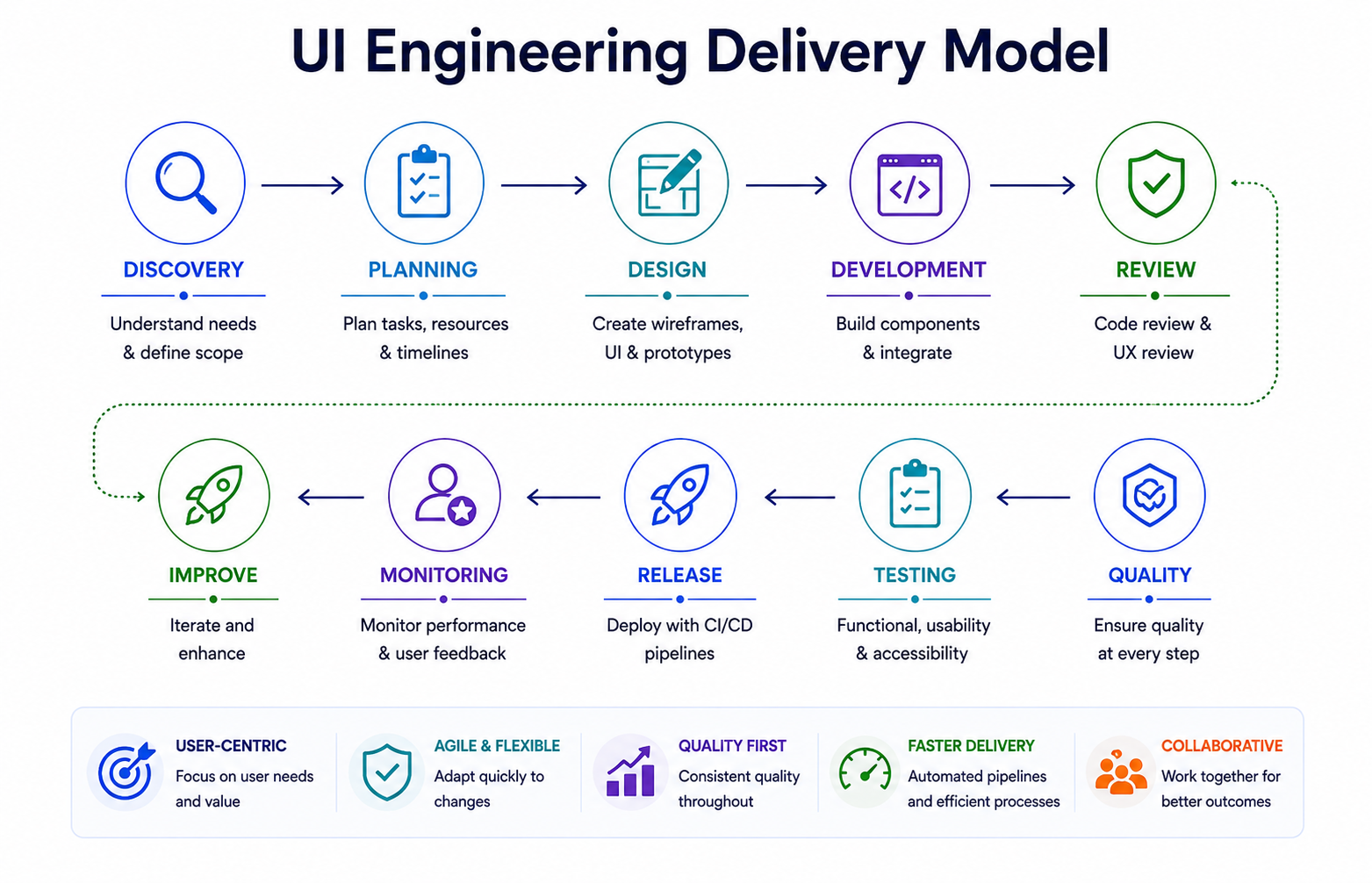
The objective of this chapter is to establish a repeatable engineering delivery framework that improves predictability, quality, and collaboration across the ERP platform.
Strategic Vision
Create an engineering delivery model that enables product teams to deliver high-quality software through structured planning, disciplined execution, continuous validation, and reliable release practices.
The delivery process should remain transparent, measurable, and adaptable as the organization grows.
Business Objectives
The Engineering Delivery Model should enable the organization to:
Improve delivery predictability.
Increase release quality.
Strengthen cross-functional collaboration.
Reduce delivery risk.
Accelerate customer value delivery.
Improve operational readiness.
Support continuous improvement.
Build sustainable engineering practices.
Delivery Principles
Every engineering activity should follow a common set of delivery principles.
Customer Value
Every sprint should deliver measurable customer or business value.
Engineering effort should contribute directly to improving product capabilities, usability, reliability, or operational efficiency.
Predictability
Delivery should be planned realistically.
Reliable commitments build confidence across Engineering, Product, and Business teams.
Incremental Delivery
Visual Reference
◆ UI Engineering Delivery Model
Large initiatives should be divided into smaller, independently deliverable increments.
Frequent delivery reduces implementation risk while enabling faster customer feedback.
Quality by Default
Quality should be integrated into every stage of delivery rather than treated as the responsibility of Quality Assurance alone.
Continuous Feedback
Feedback should be collected throughout the delivery lifecycle from engineers, designers, QA teams, business stakeholders, and customers.
The recommended engineering delivery lifecycle consists of the following stages:
1. Business Discovery 2. Requirement Analysis 3. Technical Planning 4. Sprint Planning 5. Design Review 6. Development 7. Code Review 8. Quality Assurance 9. User Acceptance Testing 10. Release Approval 11. Production Deployment 12. Post-Release Review
Every stage should have defined ownership, expected deliverables, and measurable exit criteria.
Sprint Planning
Sprint Planning establishes the execution plan for the upcoming iteration.
Planning discussions should focus on:
Business priorities
Technical dependencies
Team capacity
Risk identification
Delivery commitments
Engineering teams should avoid committing to work that exceeds realistic capacity.
Development Workflow
Development should follow a disciplined workflow.
Typical activities include:
Requirement clarification
Technical design
Feature implementation
Unit testing
Code review
Documentation updates
Integration testing
Progress should remain visible throughout the sprint.
Code Review Process
Code review protects engineering quality and promotes knowledge sharing.
Reviews should evaluate:
Business correctness
Architectural consistency
Maintainability
Performance considerations
Security implications
Test coverage
Documentation updates
The objective is collaborative improvement rather than individual approval.
Quality Assurance
Quality Assurance should begin during development rather than after implementation.
Quality activities should include:
Functional testing
Regression testing
Cross-browser validation
Accessibility verification
Performance validation
API integration testing
Quality should remain a shared engineering responsibility.
Release Management
Every production release should follow a structured release process.
Recommended release activities include:
Release planning
Feature freeze
Final validation
Deployment approval
Production verification
Monitoring
Rollback readiness
A predictable release process reduces operational risk.
Production Readiness
Before deployment, every release should satisfy predefined readiness criteria.
Typical checkpoints include:
Functional validation completed
Critical defects resolved
Performance verified
Security review completed
Documentation updated
Rollback plan available
Monitoring configured
Production readiness should be evaluated consistently for every release.
Incident Management
Despite careful planning, production issues may occur.
Engineering teams should establish a structured incident response process that includes:
Incident identification
Severity assessment
Root cause analysis
Customer communication
Resolution
Post-incident review
The objective is not only to restore service quickly but also to prevent recurrence.
Continuous Improvement
Every release provides valuable learning opportunities.
Engineering teams should regularly review:
Delivery performance
Defect trends
Production incidents
Sprint outcomes
Customer feedback
Team observations
Insights gained from retrospectives should influence future planning and engineering practices.
Engineering Recommendations
Immediate Priorities
Standardize the engineering delivery lifecycle.
Strengthen sprint planning practices.
Improve code review quality.
Establish production readiness checklists.
Medium-term Priorities
Improve release management processes.
Strengthen incident management.
Standardize delivery metrics.
Increase cross-functional collaboration.
Long-term Priorities
Continuously optimize delivery workflows.
Measure engineering maturity through delivery outcomes.
Improve operational excellence.
Build a predictable and scalable engineering delivery organization.
Leadership Perspective
Delivery excellence is not achieved through speed alone.
High-performing engineering organizations consistently deliver software because they invest in planning, ownership, quality, communication, and continuous learning.
A mature delivery model balances execution speed with engineering discipline, enabling sustainable product development over the long term.
A disciplined engineering delivery model transforms software development into a predictable, repeatable, and continuously improving process.
By aligning planning, execution, quality assurance, release management, and operational learning, organizations create an environment where engineering teams can deliver enterprise software with confidence while supporting long-term business growth.
The following chapter focuses on Engineering Excellence Framework, defining the quality, security, performance, and operational practices that protect product quality throughout its lifecycle.
12
Chapter 12
Engineering Excellence Framework
Excellence Context
Engineering excellence is achieved through disciplined execution, measurable quality, operational reliability, and a commitment to continuous improvement. It is not a milestone—it is an organizational capability.
Build right from the start with measurable standards.
02Perform
Optimize for speed, reliability, and operational stability.
03Improve
Learn, measure, and refine through continuous feedback.
Executive Context
Enterprise software is expected to operate reliably under continuous change.
New releases, evolving customer expectations, increasing user traffic, regulatory requirements, and expanding business workflows place constant pressure on engineering teams.
Sustainable product development therefore requires more than feature delivery.
Engineering organizations must establish a framework that consistently protects product quality, application performance, operational stability, and platform security throughout the software lifecycle.
The objective of this framework is to make engineering excellence repeatable rather than dependent on individual experience.
Strategic Vision
Build an engineering organization where every release demonstrates predictable quality, strong operational discipline, measurable performance, and proactive risk management.
Engineering excellence should become part of everyday development rather than a final validation activity before production deployment.
Business Objectives
The Engineering Excellence Framework should enable the organization to:
Improve software quality.
Strengthen operational reliability.
Enhance application performance.
Integrate security into every stage of development.
Reduce production risk.
Improve engineering maturity.
Support continuous improvement.
Deliver sustainable business value.
Quality Engineering
Visual Reference
◆ Engineering Excellence Framework
Quality begins long before software reaches production.
It starts with understanding business requirements, continues through architecture and implementation, and extends into production monitoring and continuous improvement.
Quality engineering should include:
Requirement validation
Technical design reviews
Automated testing
Manual validation
Accessibility verification
Regression testing
Production monitoring
Customer feedback analysis
Quality should be considered an engineering responsibility shared by the entire product team.
Performance Engineering
Performance directly influences user confidence and product adoption.
Performance should therefore be treated as an architectural requirement rather than an optimization exercise.
Engineering teams should continuously monitor:
Initial page load time
API response time
Rendering efficiency
Bundle size
Memory utilization
Network requests
User interaction latency
Performance targets should be reviewed as part of every major release.
Security Engineering
Security should be integrated into the engineering lifecycle from the beginning.
Frontend applications play an important role in protecting business data through responsible implementation practices.
Recommended security practices include:
Secure authentication
Role-based authorization
Input validation
Secure session handling
API protection
Secure storage of sensitive information
Dependency management
Security reviews
Security is a continuous engineering discipline rather than a one-time activity.
Operational Reliability
Reliable software earns customer trust.
Operational reliability should focus on ensuring that systems remain stable, recover quickly from failures, and provide visibility into production behaviour.
Engineering teams should establish practices for:
Production monitoring
Health checks
Error tracking
Incident response
Root cause analysis
Service recovery
Release verification
Reliability improves when operational learning becomes part of engineering culture.
Engineering Metrics
Improvement requires measurement.
Engineering organizations should regularly review indicators such as:
Deployment frequency
Lead time for change
Defect trends
Production incidents
Mean Time to Recovery (MTTR)
Release success rate
Performance benchmarks
Customer-reported issues
These metrics should guide engineering decisions rather than serve solely as reporting targets.
Continuous Improvement
Every sprint, release, and production incident provides an opportunity to improve.
Continuous improvement should be supported through:
Sprint retrospectives
Architecture reviews
Engineering audits
Knowledge-sharing sessions
Post-incident reviews
Technical debt planning
Improvement should become a routine engineering practice rather than a reaction to problems.
Engineering Recommendations
Immediate Priorities
Define quality engineering standards.
Integrate security into the development lifecycle.
Establish performance baselines.
Standardize operational monitoring.
Medium-term Priorities
Strengthen engineering metrics and reporting.
Improve incident response processes.
Expand automated quality validation.
Increase engineering audit coverage.
Long-term Priorities
Build a culture of engineering excellence.
Continuously improve quality, security, and operational maturity.
Measure engineering success through objective metrics.
Establish engineering excellence as a long-term organizational capability.
Leadership Perspective
Engineering excellence is established through consistent habits rather than occasional initiatives.
Organizations that invest in quality, reliability, security, and operational discipline create products that customers trust and engineering teams can confidently evolve.
Leadership should continuously reinforce engineering practices that strengthen the platform over time.
Key Takeaways
Quality is a shared engineering responsibility.
Performance should be designed into the product.
Security must be integrated throughout the development lifecycle.
Engineering excellence is the result of disciplined engineering practices applied consistently across planning, development, testing, deployment, and operations.
By integrating quality engineering, performance optimization, security, operational reliability, and continuous improvement into a unified framework, organizations create products that remain dependable, scalable, and maintainable throughout their lifecycle.
The following chapter explores AI-Augmented Engineering, demonstrating how Artificial Intelligence can improve engineering productivity, accelerate software delivery, and support better technical decision-making across the development lifecycle.
13
Chapter 13
AI-Augmented Engineering
AI Engineering Context
Artificial Intelligence should enhance engineering capability, not replace engineering judgment. The strongest engineering organizations use AI to improve productivity while preserving architectural discipline, code quality, and human accountability.
Human ownership of architecture, quality, and decisions.
02Secure
AI adoption governed by security and engineering discipline.
03Augment
AI that accelerates design, build, test, and documentation.
Executive Context
Artificial Intelligence has fundamentally changed how software is designed, developed, reviewed, tested, and documented.
Tasks that previously required hours of manual effort can now be completed in minutes with AI assistance. However, increased development speed alone does not guarantee better software.
Enterprise engineering teams must establish clear principles for adopting AI responsibly. Every AI-assisted recommendation should be evaluated through engineering judgment, architectural standards, security requirements, and business objectives.
The objective is to create an engineering organization where AI improves productivity without compromising software quality or long-term maintainability.
Strategic Vision
Build an AI-enabled engineering organization where developers use Artificial Intelligence as a collaborative engineering assistant for design, implementation, documentation, testing, and continuous improvement.
AI should become a productivity multiplier that strengthens engineering capability rather than replacing technical expertise.
Business Objectives
AI-Augmented Engineering should enable the organization to:
Improve engineering productivity.
Accelerate software delivery.
Enhance engineering documentation.
Strengthen software quality.
Improve engineering decision-making.
Reduce repetitive engineering effort.
Encourage continuous learning.
Support responsible AI adoption.
Engineering Principles
AI adoption should follow a common set of principles.
Human Accountability
Engineers remain responsible for every technical decision.
AI may generate recommendations, but ownership of architecture, implementation, security, and production quality always belongs to the engineering team.
Engineering First
Engineering standards should never be relaxed because AI generated the implementation.
Every contribution should satisfy the same quality expectations regardless of how it was created.
Security by Design
Sensitive business information, customer data, credentials, and proprietary source code should only be shared with approved AI tools under established organizational policies.
AI usage must comply with the organization's security and privacy requirements.
Continuous Learning
AI should accelerate learning rather than replace it.
Engineers should understand why a solution works instead of accepting generated code without analysis.
Organizations that combine AI with strong engineering fundamentals will consistently outperform those that rely only on automation.
AI Across the Engineering Lifecycle
Artificial Intelligence can improve every stage of software delivery.
Product Discovery
AI can assist with:
Requirement clarification
User story refinement
Acceptance criteria generation
Business workflow documentation
Solution Design
AI can support:
Architecture brainstorming
Technical trade-off analysis
API design suggestions
Database modelling discussions
System documentation
Final architectural decisions should always be reviewed by experienced engineers.
Development
Visual Reference
◆ AI-Augmented UI Engineering Workflow
AI can improve implementation by assisting with:
Code generation
Refactoring
Boilerplate reduction
API integration
Error handling
Type definitions
Code explanation
AI should accelerate implementation rather than replace engineering thinking.
Code Review
AI can assist reviewers by identifying:
Code duplication
Complexity
Naming inconsistencies
Missing validation
Performance concerns
Potential security issues
Final approval should remain a human engineering responsibility.
Testing
AI can support:
Unit test generation
Integration test suggestions
Edge case identification
Test documentation
Mock data creation
Testing strategy should continue to be defined by engineering teams.
Documentation
AI significantly improves documentation quality by assisting with:
API documentation
Component documentation
Architecture summaries
Release notes
Technical playbooks
Knowledge base updates
Documentation should remain synchronized with engineering changes.
AI Governance
Responsible AI adoption requires governance.
Recommended governance includes:
Approved AI tools
Usage policies
Security reviews
Prompt guidelines
Output validation
Intellectual property considerations
Regular compliance reviews
Governance establishes trust while encouraging innovation.
Measuring Success
The impact of AI should be evaluated through measurable engineering outcomes rather than subjective impressions.
Representative indicators include:
Development cycle time
Documentation coverage
Test automation growth
Code review efficiency
Engineering productivity
Defect trends
Developer satisfaction
Time saved on repetitive tasks
These metrics should guide continuous improvement while maintaining engineering quality.
Engineering Recommendations
Immediate Priorities
Define AI usage policies.
Approve secure AI development tools.
Establish prompt engineering guidelines.
Train engineering teams on responsible AI usage.
Medium-term Priorities
Integrate AI into development workflows.
Improve AI-assisted documentation.
Expand AI-supported testing and code review.
Measure engineering productivity improvements.
Long-term Priorities
Build an AI-first engineering culture.
Continuously refine AI governance.
Improve engineering decision-making through AI insights.
Establish AI as a trusted engineering capability across the organization.
Leadership Perspective
Artificial Intelligence should be viewed as an engineering capability rather than a replacement for engineers.
Organizations that establish clear governance, invest in engineering fundamentals, and encourage responsible AI adoption will achieve sustainable productivity gains while protecting architectural integrity and software quality.
Engineering leadership remains essential because AI accelerates execution but does not replace experience, judgment, or accountability.
Key Takeaways
AI should augment engineering, not replace it.
Human accountability remains essential.
Security and privacy must guide AI adoption.
Engineering standards apply equally to AI-assisted code.
AI is most valuable when integrated across the software delivery lifecycle.
Artificial Intelligence represents one of the most significant opportunities to improve engineering productivity.
When combined with disciplined engineering practices, strong governance, and experienced technical leadership, AI enables organizations to deliver software more efficiently while maintaining the quality, reliability, and architectural consistency expected from modern enterprise platforms.
The following chapter presents a practical 90-Day Engineering Transformation Roadmap, translating the principles described throughout this blueprint into a structured implementation plan.
14
Chapter 14
90-Day Transformation Roadmap
Transformation Context
Transformation is achieved through disciplined execution. Small, well-planned improvements delivered consistently create stronger engineering organizations than large initiatives executed without structure.
Foundation phase: standards, alignment, and quick wins.
02Standardize
Acceleration phase: design system and delivery improvements.
03Scale
Optimization phase: platform, AI, and governance at scale.
Executive Context
Engineering transformation should be approached as a structured program rather than a collection of independent improvement initiatives.
Attempting to modernize architecture, processes, tooling, engineering standards, and team practices simultaneously often leads to delivery disruption and organizational resistance.
A phased implementation roadmap enables the organization to improve engineering maturity while continuing to deliver business value.
The objective of this roadmap is to establish a practical sequence of improvements that can be adopted incrementally with measurable outcomes.
Strategic Vision
Create a structured ninety-day implementation plan that strengthens engineering foundations without interrupting ongoing product development.
The roadmap emphasizes sustainable improvement through progressive adoption of engineering standards, platform capabilities, governance, and delivery practices.
Business Objectives
The transformation roadmap should enable the organization to:
Improve engineering maturity.
Strengthen technical foundations.
Standardize engineering practices.
Accelerate delivery capability.
Improve collaboration across teams.
Reduce technical debt.
Increase engineering productivity.
Support long-term organizational growth.
Guiding Principles
The transformation program should follow four guiding principles.
Improve incrementally rather than attempting large-scale change.
Prioritize engineering foundations before advanced capabilities.
Measure progress using objective engineering metrics.
Balance product delivery with organizational improvement.
Phase 1 — Foundation (Days 1–30)
The first phase establishes the engineering baseline.
Engineering Assessment
Visual Reference
◆ 90-Day UI Engineering Transformation Roadmap
Review the current frontend architecture.
Identify technical debt.
Evaluate delivery workflows.
Assess component reuse.
Review engineering documentation.
Engineering Standards
Publish engineering standards.
Standardize project structure.
Define coding conventions.
Introduce Architecture Decision Records (ADR).
Establish code review expectations.
Team Alignment
Clarify engineering roles.
Define ownership boundaries.
Introduce regular architecture discussions.
Establish technical communication channels.
Expected Outcomes
Shared engineering standards.
Clear ownership model.
Improved technical visibility.
Baseline engineering metrics.
Phase 2 — Standardization (Days 31–60)
The second phase focuses on platform consistency.
Design System
Consolidate reusable UI patterns.
Standardize typography.
Define spacing system.
Publish design tokens.
Improve accessibility consistency.
Component Library
Identify reusable components.
Remove duplicate implementations.
Improve documentation.
Introduce versioning.
Define contribution guidelines.
Delivery Improvements
Improve sprint planning.
Strengthen release readiness.
Expand automated testing.
Improve documentation quality.
Expected Outcomes
Higher component reuse.
Better user experience consistency.
Faster feature development.
Improved engineering collaboration.
Phase 3 — Scale & Optimization (Days 61–90)
The final phase focuses on long-term engineering capability.
Platform Optimization
Improve application performance.
Strengthen security practices.
Enhance observability.
Optimize build pipelines.
Improve deployment reliability.
AI-Augmented Engineering
Introduce approved AI workflows.
Improve documentation automation.
Expand AI-assisted code reviews.
Standardize engineering prompts.
Measure productivity improvements.
Engineering Governance
Review architecture decisions.
Evaluate engineering metrics.
Plan future technical investments.
Prioritize technical debt reduction.
Expected Outcomes
Improved engineering maturity.
Faster delivery cycles.
Better operational stability.
Increased developer productivity.
Sustainable engineering practices.
Measuring Progress
The transformation should be evaluated using measurable indicators.
Recommended metrics include:
Delivery Predictability
Lead Time for Change
Component Reuse
Code Review Turnaround Time
Production Stability
Documentation Coverage
Engineering Satisfaction
Customer-Reported Defects
Progress should be reviewed regularly and used to refine future improvement initiatives.
These risks can be reduced through clear communication, phased implementation, leadership support, and continuous feedback.
Engineering Recommendations
Immediate Priorities
Complete engineering assessment.
Establish engineering standards.
Clarify team ownership.
Define baseline engineering metrics.
Medium-term Priorities
Expand Design System adoption.
Increase component reuse.
Improve release processes.
Strengthen engineering governance.
Long-term Priorities
Continuously improve engineering maturity.
Reduce technical debt systematically.
Scale AI-assisted engineering practices.
Establish a culture of continuous organizational improvement.
Leadership Perspective
Successful transformation is not driven by process alone.
It requires visible leadership, realistic planning, technical credibility, and consistent reinforcement of engineering standards.
Organizations that improve incrementally while maintaining delivery momentum are more likely to achieve lasting engineering maturity than those pursuing large-scale change without a structured roadmap.
Key Takeaways
Transformation should be incremental.
Engineering foundations come before optimization.
Standards enable consistency.
Governance sustains long-term improvement.
Progress should be measured objectively.
Leadership determines the success of organizational change.
Chapter Summary
A successful engineering transformation balances product delivery with continuous improvement.
By implementing changes through structured phases, organizations strengthen architecture, engineering practices, delivery capability, and operational maturity while minimizing disruption to ongoing business priorities.
The final chapter presents the Future Engineering Vision, describing how these investments establish a sustainable platform capable of supporting continuous innovation, organizational excellence, and long-term business growth.
15
Chapter 15
Future Vision
Future Context
The long-term success of an engineering organization is determined not by the technologies it adopts today, but by the engineering capabilities it continues to build over time.
Long-term direction for platform, culture, and capability.
02Evolve
Continuous platform innovation and engineering maturity.
03Sustain
Leadership, measurement, and lasting organizational growth.
Executive Context
Enterprise software continues to evolve at an unprecedented pace.
Customer expectations, business models, regulatory requirements, cloud platforms, Artificial Intelligence, and engineering practices will continue to reshape how enterprise applications are designed and delivered.
Organizations that invest only in short-term feature delivery often struggle to adapt to future change.
Organizations that invest in engineering capability, architectural discipline, and continuous improvement build products that remain competitive for years.
This blueprint is intended to establish those long-term foundations.
Strategic Vision
Build an engineering organization where architecture, engineering standards, delivery processes, design systems, reusable components, and Artificial Intelligence operate together as a unified platform for continuous innovation.
Engineering should become a strategic business capability that enables sustainable growth rather than simply supporting software development.
Business Objectives
The long-term engineering vision should enable the organization to:
Build sustainable engineering capability.
Continuously improve engineering maturity.
Strengthen architectural governance.
Accelerate innovation responsibly.
Improve organizational adaptability.
Invest in engineering talent and leadership.
Support long-term platform evolution.
Create lasting business value through engineering excellence.
Engineering Maturity
Visual Reference
◆ UI Engineering Strategy Framework
Engineering maturity is achieved through disciplined evolution.
The organization should progressively strengthen:
Architecture Governance
Design System Adoption
Component Reuse
Engineering Standards
Automated Quality Practices
Release Reliability
Security Engineering
Performance Engineering
AI-Augmented Development
Knowledge Management
Every improvement should simplify future engineering work.
Platform Evolution
The frontend platform should continue evolving without disrupting existing products.
Future investment areas include:
Shared Platform Services
Modular Business Capabilities
Improved Developer Experience
Intelligent Automation
Enterprise Observability
Advanced Analytics
Workflow Orchestration
Cross-Product Integration
Platform evolution should remain continuous rather than project-based.
Engineering Culture
Long-term engineering success depends on culture as much as technology.
The organization should cultivate a culture that values:
Ownership
Technical Curiosity
Collaboration
Simplicity
Transparency
Continuous Learning
Knowledge Sharing
Customer Focus
Engineering Excellence
Culture should be reflected in everyday engineering decisions rather than formal documentation.
Leadership Responsibility
Engineering leaders should continuously evaluate how the organization is evolving.
Leadership responsibilities include:
Protecting architectural integrity.
Investing in engineering capability.
Developing future technical leaders.
Reducing technical debt.
Encouraging experimentation.
Maintaining engineering standards.
Aligning engineering priorities with business strategy.
Leadership should focus on building systems that continue to improve as teams grow.
Innovation Strategy
Innovation should become part of normal engineering operations.
The organization should encourage:
Technical Experimentation
Internal Proof of Concepts
Process Automation
AI-Assisted Engineering
Developer Tooling Improvements
Platform Modernization
Continuous Architectural Refinement
Innovation should be measured by business value rather than novelty.
Measuring Long-Term Success
The effectiveness of the engineering organization should be evaluated using long-term indicators such as:
Product Stability
Engineering Productivity
Customer Satisfaction
Platform Scalability
Release Confidence
Component Reuse
Architecture Consistency
Developer Retention
Knowledge Sharing
Engineering Maturity
These indicators provide a more meaningful assessment than short-term delivery metrics alone.
Engineering Recommendations
Immediate Priorities
Strengthen engineering governance.
Expand reusable platform capabilities.
Continue investing in engineering talent.
Establish long-term engineering metrics.
Medium-term Priorities
Improve platform scalability.
Expand AI-assisted engineering practices.
Strengthen knowledge management.
Increase organizational engineering maturity.
Long-term Priorities
Build a self-improving engineering organization.
Continuously evolve architecture and engineering standards.
Foster a culture of innovation and operational excellence.
Position engineering as a long-term competitive advantage.
Leadership Perspective
Technology will continue to change.
Engineering principles will not.
Organizations that consistently invest in architecture, people, standards, and engineering culture create platforms capable of adapting to future technologies without losing stability or delivery capability.
The strongest engineering organizations are those that continuously improve while remaining disciplined in their execution.
Key Takeaways
Engineering capability is a long-term investment.
Sustainable architecture enables sustainable business growth.
Culture determines engineering maturity.
Innovation should complement operational discipline.
Leadership creates the environment for engineering excellence.
Continuous improvement is the foundation of long-term success.
Closing Statement
This blueprint presents a strategic framework for building and scaling an Enterprise ERP Frontend Engineering organization.
Its recommendations are intended to support informed decision-making, encourage engineering discipline, strengthen collaboration, and establish a platform capable of sustained product evolution.
While technologies will continue to evolve, the principles described throughout this document provide a durable foundation for engineering organizations committed to delivering reliable, maintainable, and high-quality enterprise software.
Final Note
Engineering excellence is not achieved through individual effort alone.
It is the outcome of clear vision, disciplined execution, shared ownership, continuous learning, and thoughtful leadership.
Organizations that consistently invest in these capabilities build products that remain valuable long after the underlying technologies have changed.
This blueprint is intended to serve as a long-term strategic reference for engineering leaders committed to building scalable platforms, high-performing teams, and sustainable enterprise software.